A description of how people actually choose between risky options, proposed by Daniel Kahneman and Amos Tversky in 1979 as an alternative to expected utility theory. It is descriptive rather than prescriptive: it claims to say what people do, not what they should do.

Expected utility theory holds that a person evaluates a gamble by weighting the utility of each outcome by its probability and choosing the highest total. It is elegant, it follows from a small set of reasonable axioms, and it was the standard model of decision under risk.
It also mispredicts choices consistently, and the failures are systematic rather than random. People buy insurance and lottery tickets at once. They treat a change from certainty to near-certainty as much larger than an equivalent change in the middle of the probability range. And the same choice presented in two logically equivalent ways gets two different answers.
The theory replaces expected utility with a value function over changes and a weighting function over probabilities.
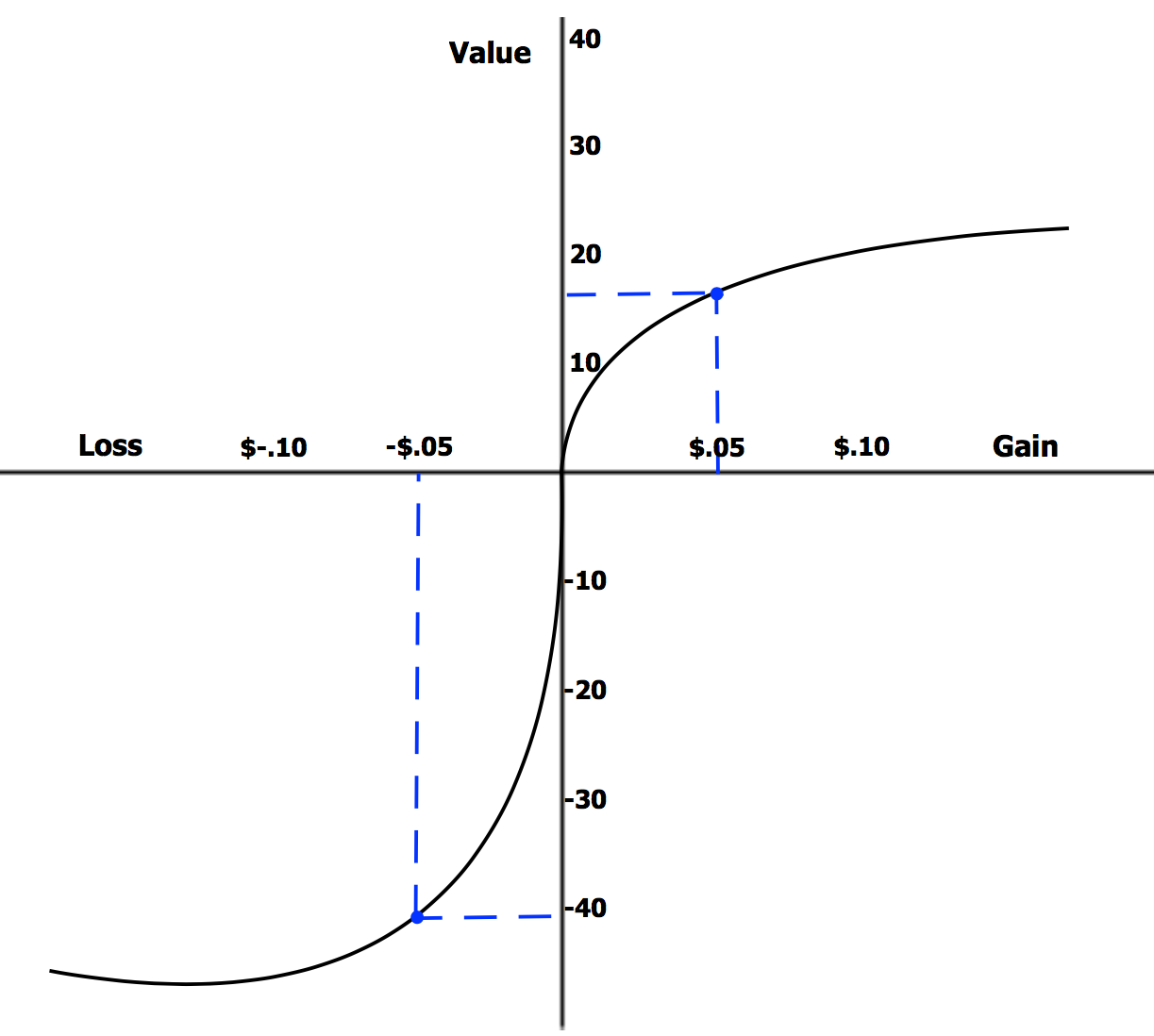
Reference dependence is the foundation. Outcomes are evaluated as gains or losses relative to a reference point, usually the status quo, rather than as final states of wealth. This is a departure from the standard model, in which only the final position should matter.
Diminishing sensitivity gives the value function its curvature. The difference between 100 and 200 feels larger than that between 1,100 and 1,200, on both the gain and the loss side. The result is risk aversion for gains and risk seeking for losses, since a sure loss is felt disproportionately.
Loss aversion makes the function steeper for losses than gains. Tversky and Kahneman's 1992 estimate put the ratio around 2.25, and the general claim is that losses loom larger than equivalent gains.
Probability weighting replaces probabilities with decision weights. Small probabilities are overweighted and moderate to large ones underweighted, and there is a discontinuity at certainty. This is what allows the same person to buy a lottery ticket and an insurance policy, since both involve overweighting a small chance.
Together these produce the fourfold pattern of risk attitudes: risk seeking for small-probability gains and large-probability losses, risk aversion for large-probability gains and small-probability losses. This pattern is the theory's most distinctive prediction and it is well replicated.

Framing follows directly. If the reference point can be shifted by wording, then preferences can be reversed by wording, and the classic demonstration is a public health problem described in terms of lives saved or lives lost, which reverses the majority choice.
Cumulative prospect theory, published in 1992, applies the weighting to cumulative rather than individual probabilities, which fixed a technical problem in the original version and extended it to outcomes with many possible values.
The largest direct test is a multinational replication led by Kai Ruggeri, published in 2020, which ran the original 1979 items in 19 countries and 13 languages with 4,098 participants, adjusting only for local currency.
The results were largely supportive. Around 94 per cent of items replicated, with some attenuation of effect size, and twelve of thirteen theoretical contrasts held. This is a stronger replication record than most findings in behavioural science of comparable age and influence.
The theory is also the standard model in its field and has generated a substantial applied literature, including the disposition effect in finance, where investors hold losing assets too long and sell winners too early, which is a direct consequence of evaluating relative to purchase price.
Loss aversion as a general principle has been challenged directly. Nathan Novemsky and others have shown it does not appear for goods exchanged in routine transactions, and David Gal and Derek Rucker argued in 2018 that much of the evidence is better explained by inertia or by the specific experimental framing than by a general asymmetry, and that loss aversion is often assumed rather than tested. The debate is about scope: whether losses always loom larger, or whether they do so under identifiable conditions.
Parameter stability is a second issue. The curvature and loss aversion parameters are estimated from choices and vary substantially across studies, populations and elicitation methods, so the widely quoted ratio near 2 should be read as one estimate from one dataset rather than a constant.
The reference point is the theory's weakest formal element. It determines every prediction and the theory does not specify how it is set. In most experiments it is imposed by the design; outside the laboratory it may be the status quo, an expectation, an aspiration or a social comparison, and different choices give different predictions.
The endowment effect, long treated as strong evidence for loss aversion, has been shown to be sensitive to experimental procedure and to participant experience, with trading experience reducing or eliminating it, which suggests it is not a fixed feature of preference.
Prospect theory is the main reason economics now treats systematic deviations from rationality as facts to be modelled rather than noise to be averaged away. Its practical footprint is large: it underpins the design of insurance and pension defaults, explains why the same tax can be accepted as a forgone bonus and rejected as a charge, and gives a reason why presenting information differently changes decisions even when the information is identical.