The proposal that animals forage in ways that maximise net energy gained per unit time, because selection favours whatever feeding behaviour leaves the most descendants. It is less a single claim than a method for building specific, testable models of feeding decisions.

Each model states a currency to be maximised, usually net energy per unit of foraging time, a set of constraints such as handling time, travel time and digestive capacity, and a decision variable such as which prey to accept or when to leave a patch.
The currency assumption is the theory's exposed flank and its greatest strength. It is what makes the models quantitative and falsifiable, and it is also what makes them wrong whenever energy is not the binding constraint.
Given prey types differing in energy content and handling time, the model asks which should be eaten on encounter and which ignored.
The result is counterintuitive and specific. Prey types should be ranked by energy divided by handling time, and the decision to accept a lower-ranked type should depend only on the encounter rate with higher-ranked types, not on how common the lower-ranked type is. A forager should either always take a given type or never take it, with a sharp switch rather than a gradual one as conditions change.
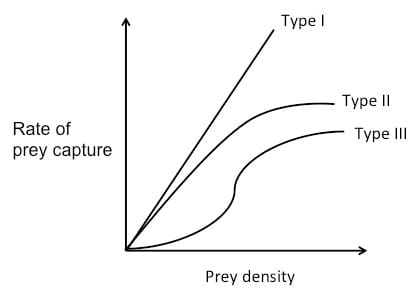
The zero-one prediction is the theory's most heavily tested claim. It holds approximately in several systems and is generally observed as a steep but not instantaneous switch, which is usually attributed to imperfect information about encounter rates rather than to a failure of the logic.
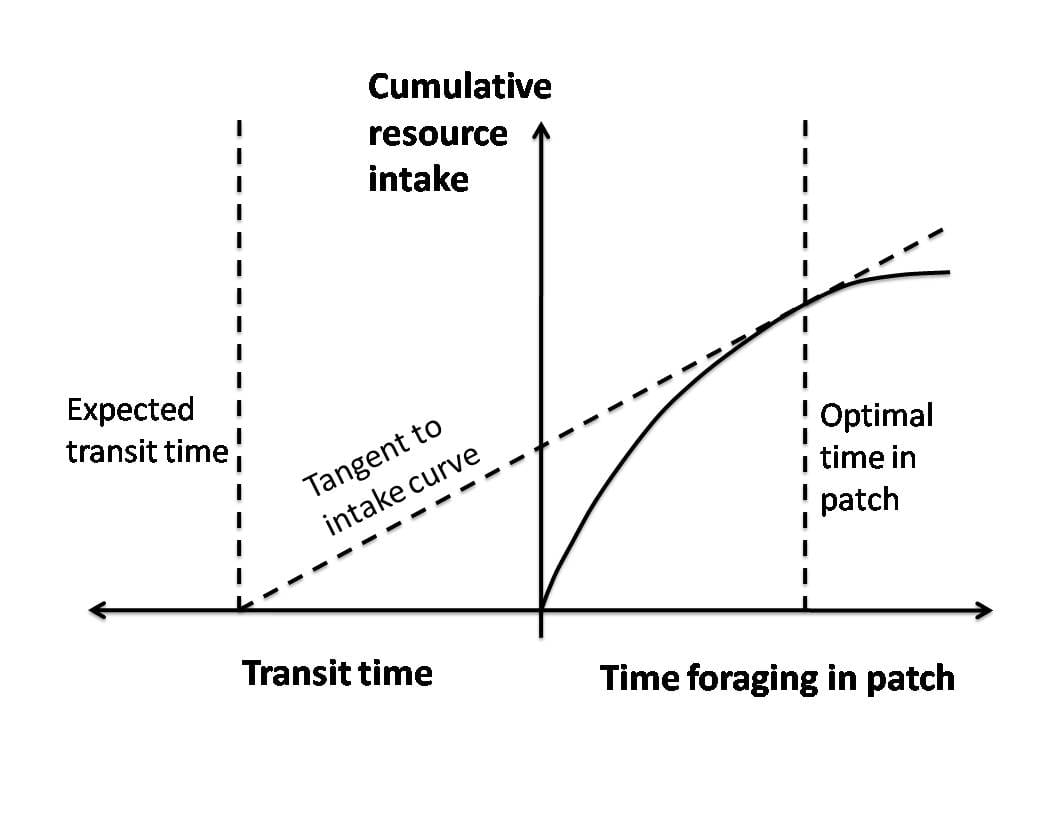
Where food occurs in patches that deplete as they are exploited, the question is when to leave. Eric Charnov's 1976 result is that a forager should leave when its instantaneous intake rate in the current patch drops to the average intake rate achievable in the habitat overall, including travel time.
Two predictions follow that can be tested without measuring anything inside the animal. Foragers should stay longer in every patch when travel between patches is longer, and should stay longer in all patches when the habitat is poorer overall, even in patches that are individually good.
Both are widely confirmed, in starlings collecting food for nestlings, in bees on inflorescences, and in parasitoid wasps on host patches. The theorem also applies well beyond foraging, to any depleting-return activity, and it has been used in that broader form in psychology and in economics.
Crows dropping whelks onto rocks choose large whelks and drop them from a height close to the one that minimises total flight energy per opened shell.
Bees adjust the number of flowers visited per inflorescence in the direction the marginal value theorem predicts as travel costs change.
Predators broaden their diets when preferred prey become scarce and narrow them when preferred prey are abundant, which is the prey choice prediction.
Central place foragers, which must return to a nest, take larger loads when travelling further, as the models require.
Energy is often not the right currency. Foragers trade intake against predation risk, frequently accepting a lower rate to stay near cover, and models that add a risk term fit far better than pure energy models.
Nutrient balance can override energy. Herbivores select for protein, sodium or particular plant secondary compounds in ways that an energy-only model cannot express, and the nutritional geometry framework was developed to handle multiple currencies at once.
Information is limited. Animals do not know encounter rates or patch quality in advance, and much observed departure from optimality is better described as sensible behaviour under uncertainty, using rules of thumb that approximate the optimum.
The deeper criticism is methodological. When a model fails, a practitioner can change the currency or add a constraint and recover the fit, so the framework as a whole is difficult to falsify even though each specific model is easy to falsify. Defenders answer that this is the normal use of an optimality framework: the value lies in the specific models it generates, and in the fact that a failure identifies the missing constraint. Critics reply that a framework which cannot fail is not doing the work its confident language implies.
Optimal foraging theory established that animal behaviour could be predicted quantitatively from first principles rather than only described, and it produced results, particularly the marginal value theorem, that outlasted the specific debate about currencies and now appear in fields with no connection to animals feeding.