For two thousand years one of Euclid's assumptions looked like it should be provable from the others. It is not. Denying it produces consistent geometries in which parallel lines behave differently, and one of them turned out to describe the universe.
Euclid's Elements, from around 300 BC, builds geometry from five postulates. Four are short and self-evident: a line can be drawn between any two points, a line can be extended, a circle can be drawn with any centre and radius, all right angles are equal.
The fifth is different in character and much longer. In the form usually quoted, given a line and a point not on it, exactly one line through that point never meets the first.
Euclid himself appears to have been uncomfortable with it, avoiding its use in early proofs. For two millennia mathematicians tried to derive it from the other four, on the assumption that something so much less elegant must be a theorem in disguise.
Every attempt failed. Several succeeded in proving it from an assumption equivalent to itself, which is a circular argument dressed up.
Giovanni Saccheri published a book in 1733 attempting a proof by contradiction: assume the postulate false, derive an absurdity. He derived a long sequence of strange but consistent results, failed to find a contradiction, and concluded, wrongly, that the strangeness was itself the contradiction. He had discovered non-Euclidean geometry and did not recognise it.
The recognition came in the 1820s and 1830s, independently and almost simultaneously.
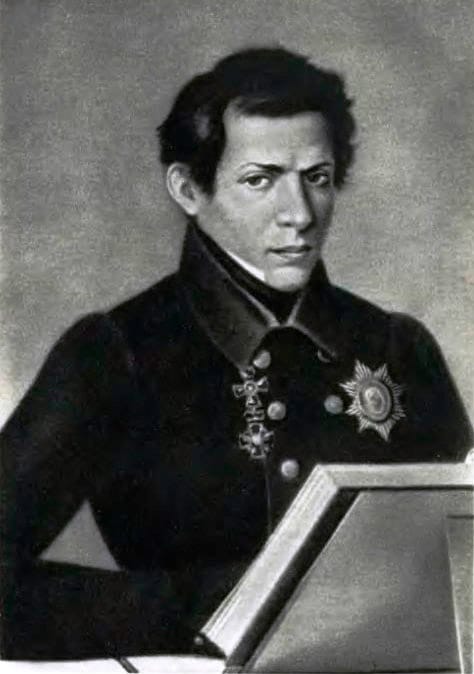
Nikolai Lobachevsky in Russia and Janos Bolyai in Hungary each developed a geometry in which infinitely many lines through a point fail to meet a given line. Carl Friedrich Gauss had reached the same conclusions earlier and never published, writing privately that he feared the outcry of the Boeotians.
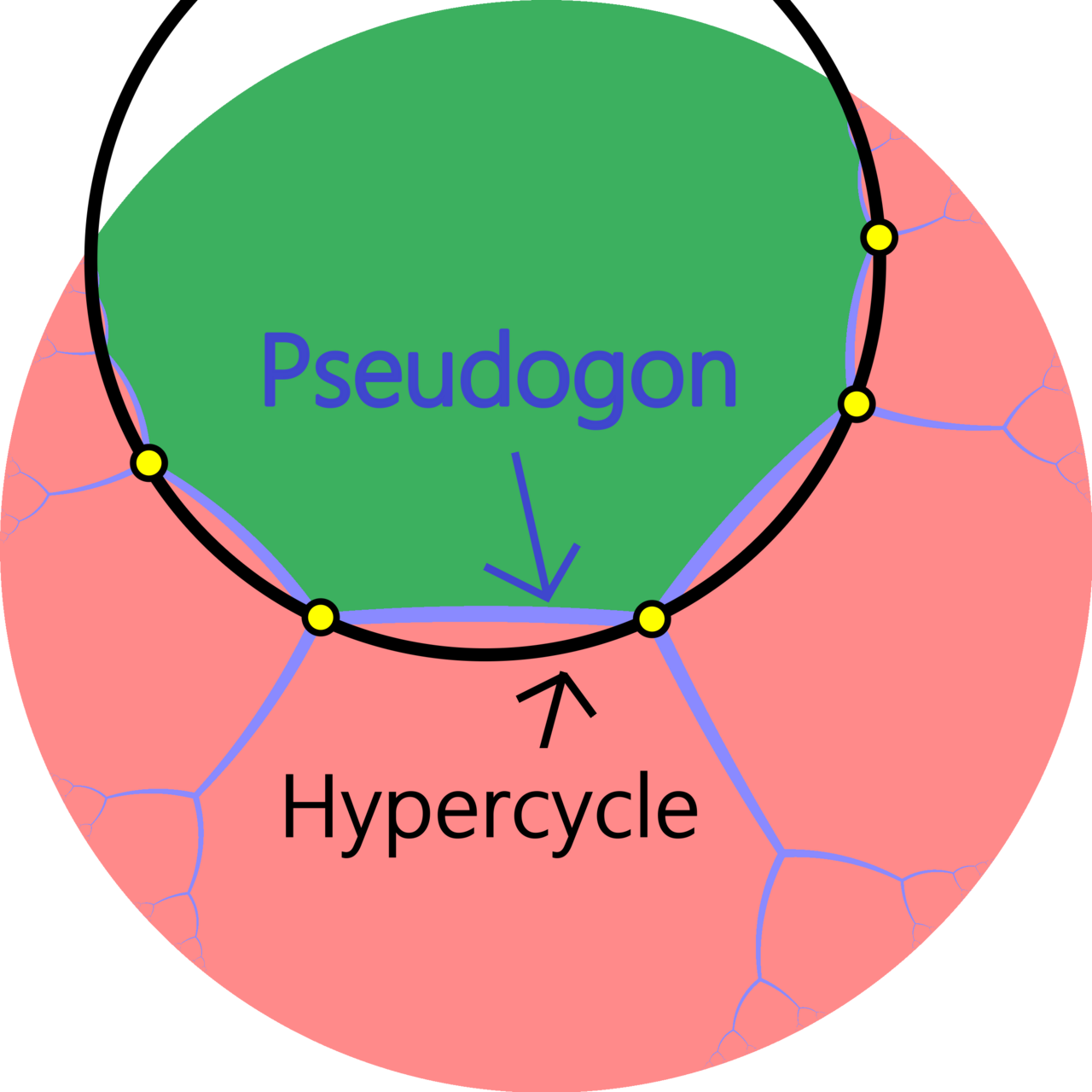
In hyperbolic geometry the angles of a triangle sum to less than 180 degrees, and the deficit grows with the triangle's area. Similar triangles of different sizes do not exist: specifying the angles fixes the size.
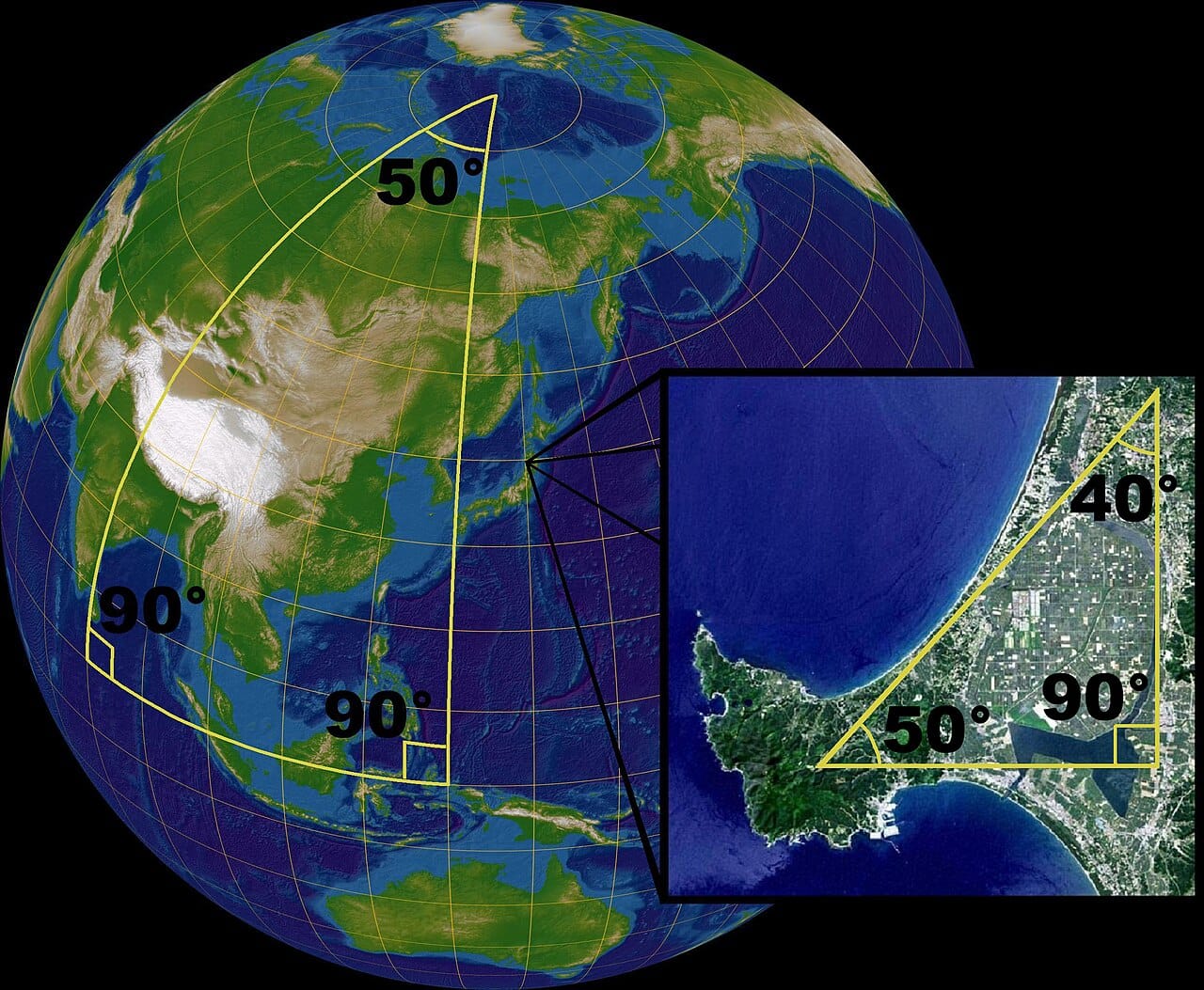
Bernhard Riemann developed the other alternative in 1854, in which no parallels exist at all. The surface of a sphere is the accessible example: great circles are the straight lines, any two of them meet, and triangle angles sum to more than 180 degrees.
Eugenio Beltrami showed in 1868 that non-Euclidean geometry can be modelled within Euclidean geometry: hyperbolic geometry describes the surface of a pseudosphere, and other models followed.
The consequence is decisive. If the non-Euclidean systems contained a contradiction, the model would translate it into a contradiction in Euclidean geometry. So the new geometries are consistent if the old one is, and they cannot be dismissed as error.
The parallel postulate is therefore independent: neither it nor its negation follows from the other four axioms. Both choices give consistent mathematics.
The consequences went well beyond geometry.
Geometry had been regarded, notably by Kant, as describing the necessary structure of space, known a priori. If several consistent geometries exist, that position is untenable, and which one describes physical space becomes an empirical question rather than a matter of pure reason.
Axioms stopped being self-evident truths and became assumptions with consequences. That reconception is the origin of the modern axiomatic method: a mathematician chooses axioms and derives what follows, and different choices give different structures, none more true than the others.
Riemann's 1854 lecture went further than surfaces, developing the geometry of spaces of any dimension with curvature varying from point to point.
Sixty years later Einstein needed exactly that machinery. General relativity describes gravity as curvature of four-dimensional spacetime, with mass determining the curvature and objects following the straightest available paths through it. Riemannian geometry is the mathematics of the theory, and without it Einstein could not have written it down.
The predictions are measured. Light bends around the Sun by the amount curved spacetime requires, confirmed in 1919. Mercury's orbit precesses by an amount Newtonian gravity could not account for and general relativity gets exactly. Clocks run slower in stronger gravitational fields, which satellite navigation must correct for continuously or accumulate errors of kilometres per day.
Space is not Euclidean. The question of which geometry describes the universe was settled by measurement, and the answer was one that mathematicians had constructed for reasons having nothing to do with physics, decades before anyone needed it.