The proposal that the great majority of genetic differences within and between species are not adaptive, but are changes with no effect on fitness that spread by chance. It does not deny natural selection; it claims that most of what is visible at the level of DNA is not the product of it.

By the mid-1960s protein sequencing and gel electrophoresis had revealed two things that were hard to reconcile with a strongly selectionist view.
Molecular variation within populations was far higher than expected. Many enzyme loci had multiple common forms in the same population, which is expensive to maintain if each variant is being actively selected.
Substitution rates between species appeared roughly constant per unit time, and similar across lineages with very different generation times, population sizes and ecological circumstances.
Motoo Kimura's 1968 argument was quantitative: if the observed rate of amino acid substitution reflected adaptive replacement, the resulting cost in differential survival would be more than any population could bear. Jack King and Thomas Jukes made a parallel case in 1969 under the deliberately provocative title of non-Darwinian evolution.
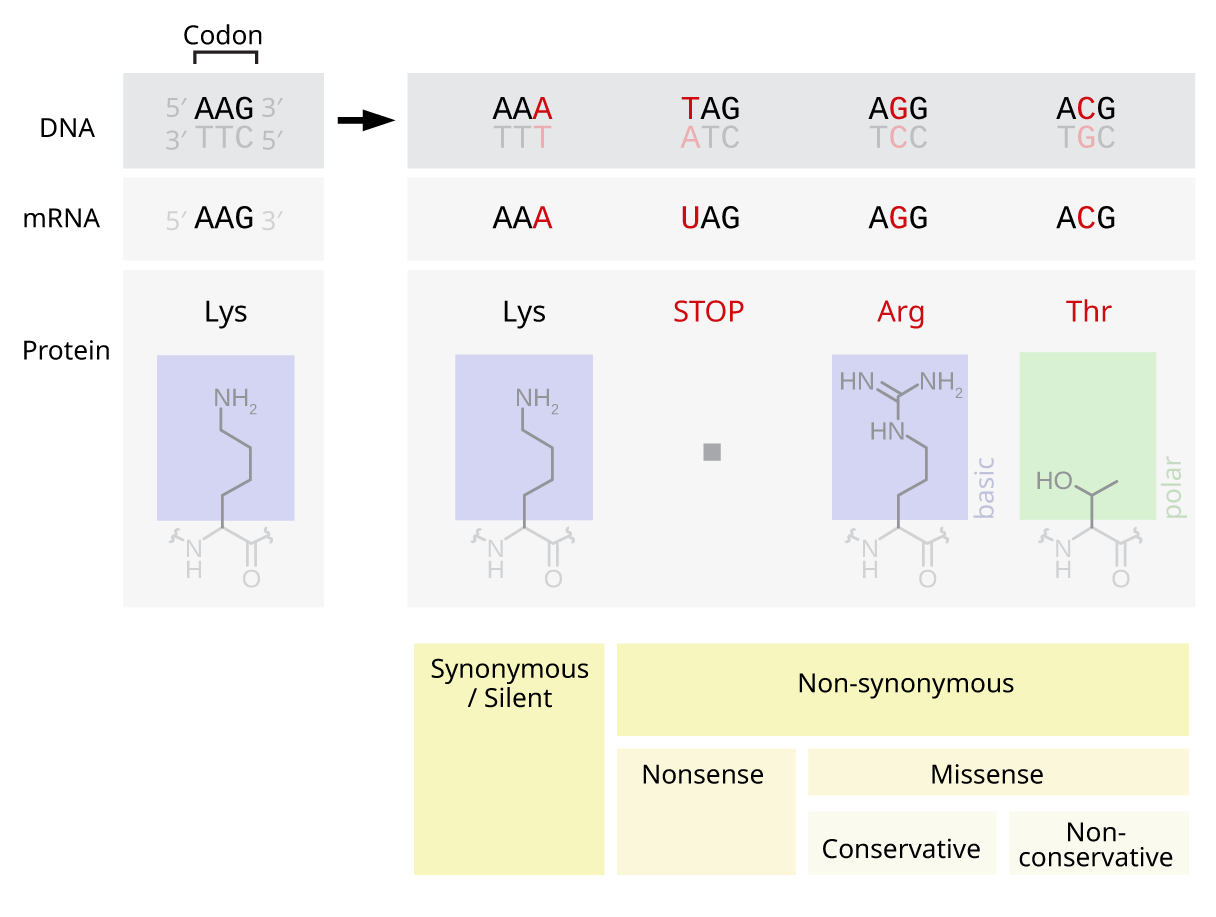
Most new mutations that are not simply eliminated as harmful are selectively neutral, and their fate is decided by random sampling from generation to generation rather than by fitness.
The mathematical result at the centre of the theory is unusually clean. For strictly neutral mutations, the rate at which they become fixed in a population equals the rate at which they arise, because population size cancels: larger populations produce more mutations but fix each one with proportionally lower probability. Constant mutation rate therefore implies a constant substitution rate, which is the molecular clock.
The theory makes a sharp prediction about which parts of the genome should change fastest, and it holds. Synonymous sites, pseudogenes and non-functional regions accumulate substitutions fastest; sites where a change alters a functional protein accumulate them slowest. Functional importance and rate of change run in opposite directions, which is what a neutral account predicts and an adaptive one does not.
Tomoko Ohta's nearly neutral theory of 1973 extended this to the more realistic case of mutations with very small effects. Whether such a mutation behaves as neutral depends on the product of its effect and the population size, so slightly deleterious changes can drift to fixation in small populations and are removed in large ones. This predicts faster protein evolution in species with small populations, which is observed.
The dispute is not whether drift occurs. It is what fraction of molecular change is adaptive, and it has run for over fifty years without resolution.
The case against a strong neutral reading has been made most forcefully by Andrew Kern and Matthew Hahn in 2018, arguing that genome-scale data reject the theory's universality. Their evidence is that in species with large populations, notably Drosophila, a substantial fraction of amino acid substitutions test as adaptive, and that signatures of selection acting on linked neutral sites are pervasive enough to shape diversity across whole genomes.
The reply, from Jeffrey Jensen and colleagues in 2019 and others since, is that the neutral theory was never a claim that adaptation is rare or unimportant, but a claim about the relative frequency of substitution types, and that rejecting it requires showing most substitutions are adaptive rather than showing that some are. They also argue that the null model role is indispensable: without a neutral expectation there is nothing against which to detect selection.
A 2024 review of the controversy concluded that much of the disagreement is about which propositions are actually being contested, since the theory has several distinct claims that are often bundled together.
The empirical picture, stated carefully, is that the adaptive fraction of amino acid substitutions is estimated at a substantial share in Drosophila and some bacteria, and a much smaller share in humans and other species with historically small populations. That is a difference between organisms rather than a single answer.
Drift occurs and fixes variants, and its strength depends on population size. Most mutations that change a protein's function are deleterious and are removed. Neutral expectations are the standard null model for detecting selection, and the tests used to argue against the theory are built on them. Rates of change vary inversely with functional constraint.
The neutral theory changed the default assumption in molecular biology from adaptation to chance, which is why finding a genomic signal of selection now requires evidence rather than a plausible story. It also produced the molecular clock, and with it most of the timescale that molecular phylogenetics assigns to the history of life.