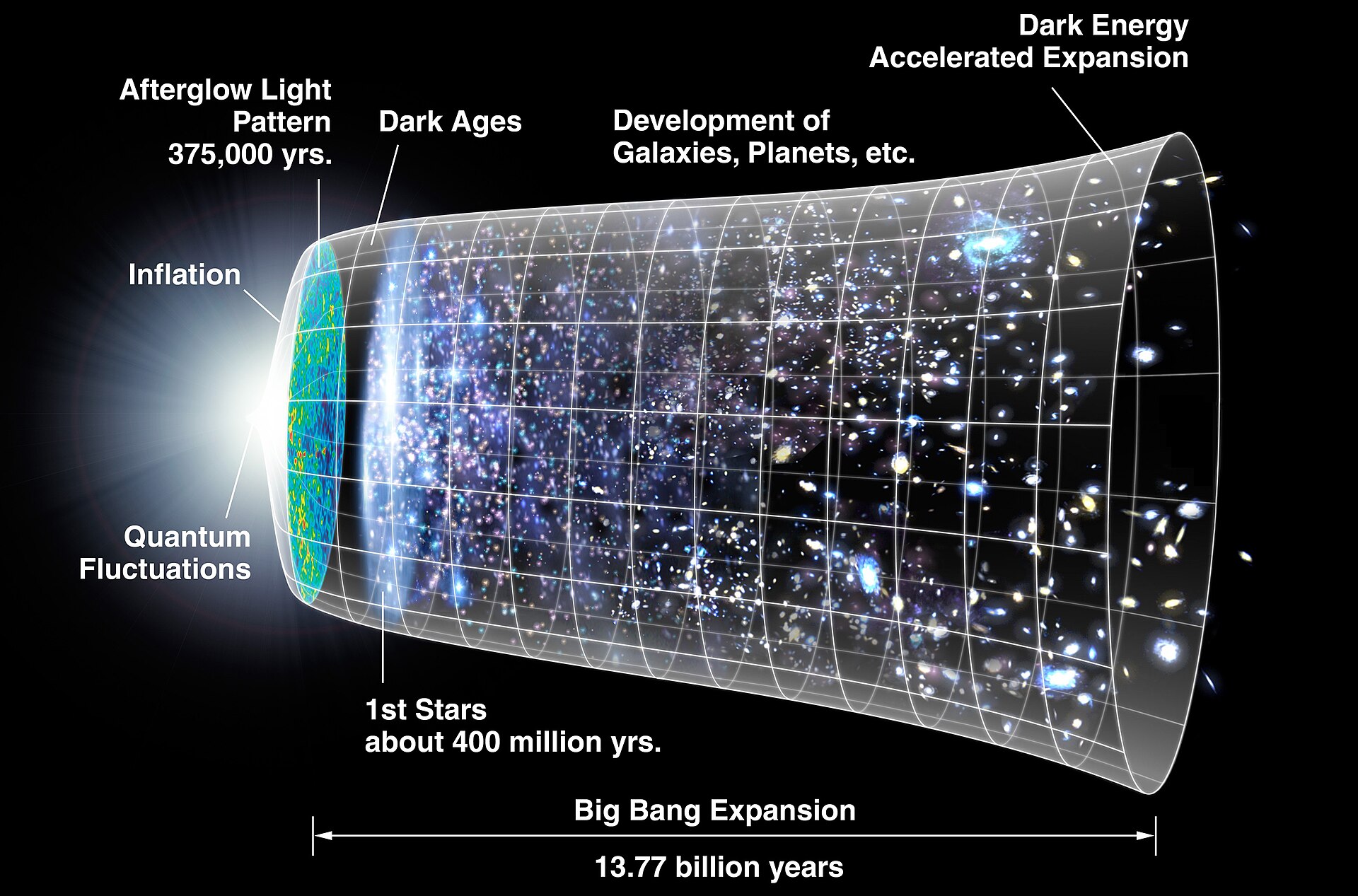
Galaxies rotate faster at their edges than the visible matter can explain. The standard answer is that unseen dark matter supplies the extra gravity. The alternative is that gravity itself behaves differently at very low accelerations, and that no dark matter exists.
Vera Rubin and Kent Ford measured the rotation of spiral galaxies in the 1970s and found that stars at the outer edges orbit as fast as those further in.
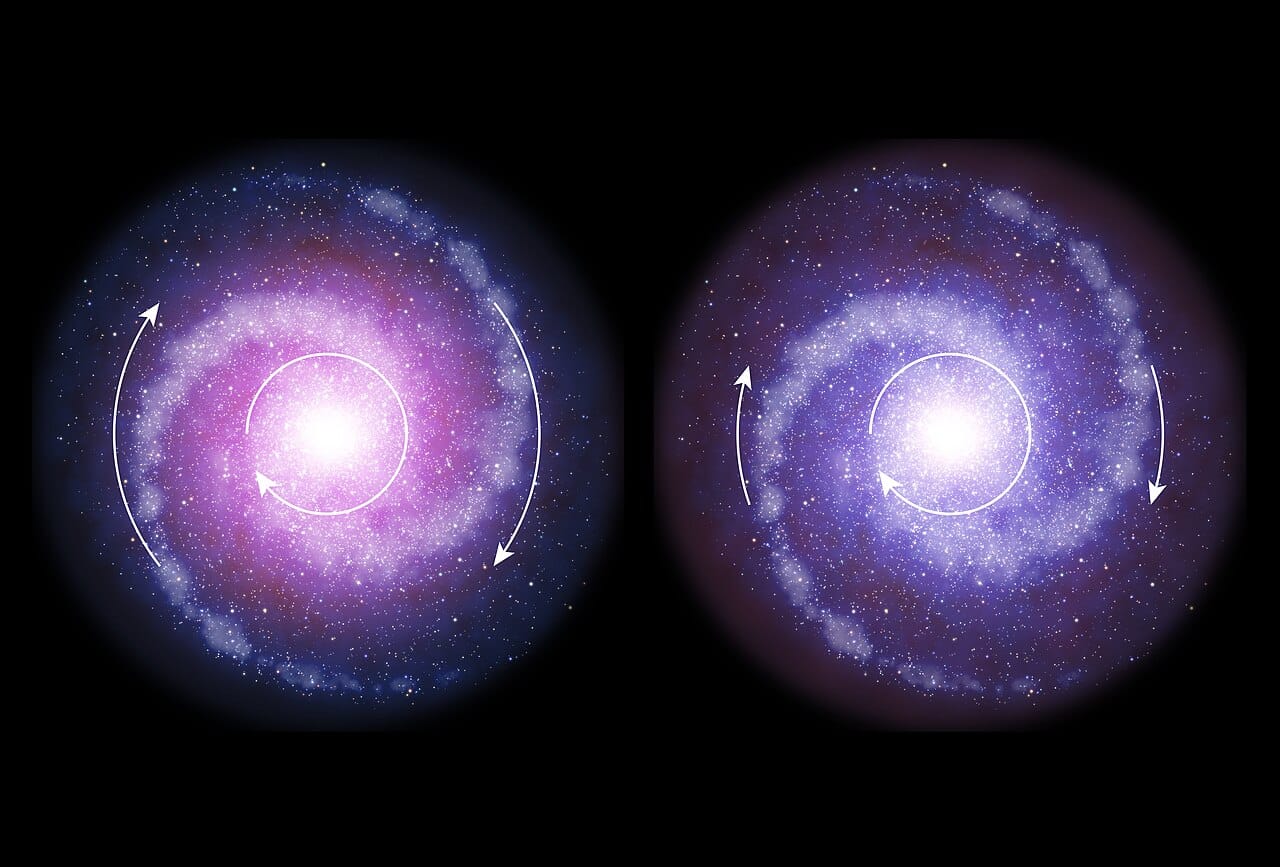
This is not what Newtonian gravity predicts. In the solar system, where nearly all the mass is central, orbital speed falls with distance: Neptune moves far more slowly than Mercury. Galaxies should behave similarly beyond the bright central region, and they do not. The curves are flat.
Either there is far more mass than is visible, distributed in an extended halo, or the law relating mass to motion is wrong at these scales.
Mordehai Milgrom proposed the second option in 1983. Modified Newtonian Dynamics postulates that below a characteristic acceleration, around 1.2 times ten to the minus ten metres per second squared, the relationship between force and acceleration departs from Newton's.
Above that threshold, which covers everything in the solar system and every laboratory experiment, the standard law holds exactly. Below it, in the outer reaches of galaxies, gravitational acceleration falls off more slowly than the inverse square law, which produces flat rotation curves without additional mass.
The threshold is a single new constant, fixed once from data and then applied everywhere.
MOND's record on galaxy rotation curves is genuinely impressive, and this is not disputed by its critics.
Given only the distribution of visible matter in a spiral galaxy, MOND predicts the full rotation curve with one universal parameter and no galaxy-specific adjustment. Dark matter models fit the same curves using a halo profile with free parameters chosen per galaxy.
The baryonic Tully-Fisher relation is the strongest case. The total visible mass of a spiral galaxy correlates extremely tightly with the fourth power of its rotation speed, across five orders of magnitude in mass and with remarkably little scatter. MOND predicts this relation exactly, as a mathematical consequence. In a dark matter framework it is a coincidence requiring the halo and the visible disc to be finely coordinated, and explaining the tightness of the relation has been persistently difficult.
The radial acceleration relation, established by Stacy McGaugh and colleagues in 2016 across 153 galaxies, shows that the observed acceleration is determined by the visible matter alone with very small scatter, even in galaxies supposedly dominated by dark matter. This is what MOND predicts and is awkward for the alternative.
MOND also predicted the properties of low surface brightness galaxies before they were measured.
The failures are at larger scales and they are serious.
Galaxy clusters are the clearest. MOND reduces the discrepancy but does not remove it, and clusters still require roughly twice as much mass as is visible. Proponents have suggested this residual could be ordinary matter not yet detected, such as cold gas or dim objects, which is a considerably weaker position than the galaxy case.
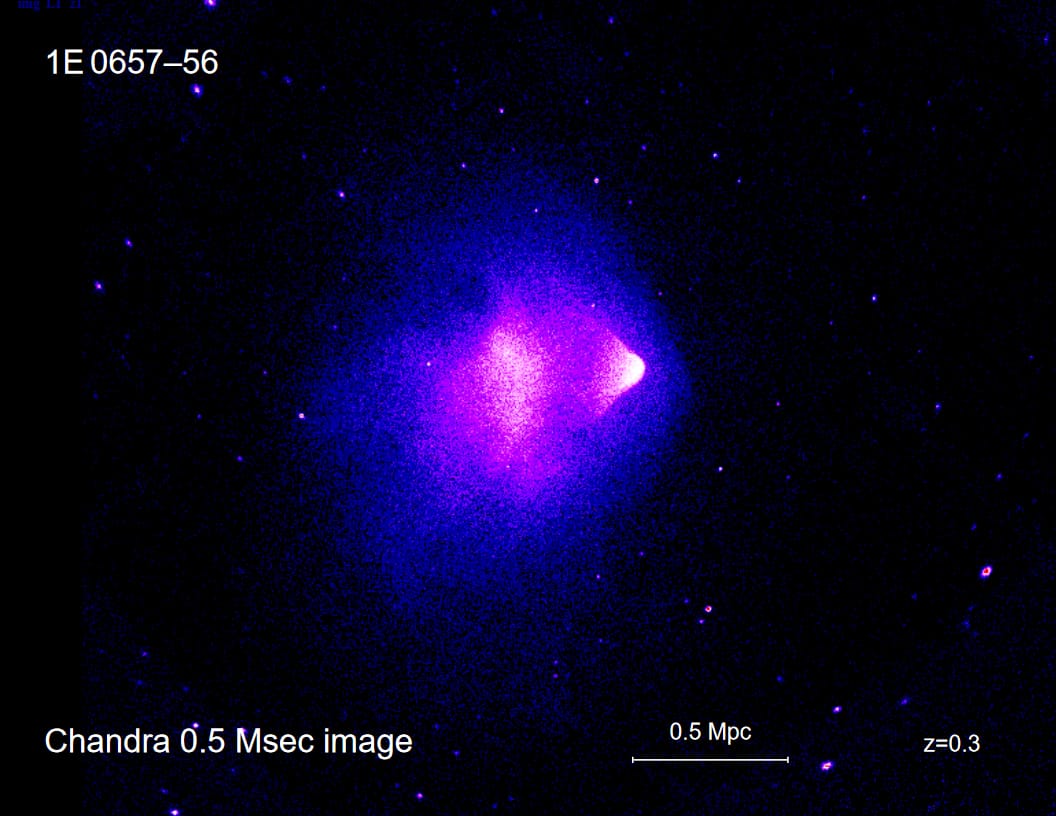
The Bullet Cluster is the case most often cited against it. Two clusters collided; the hot gas, which contains most of the ordinary mass, was slowed by the collision and lies between them, while gravitational lensing shows the mass concentrated with the galaxies that passed through. Mass and visible matter are physically separated, which a modification of gravity based on visible matter should not produce.
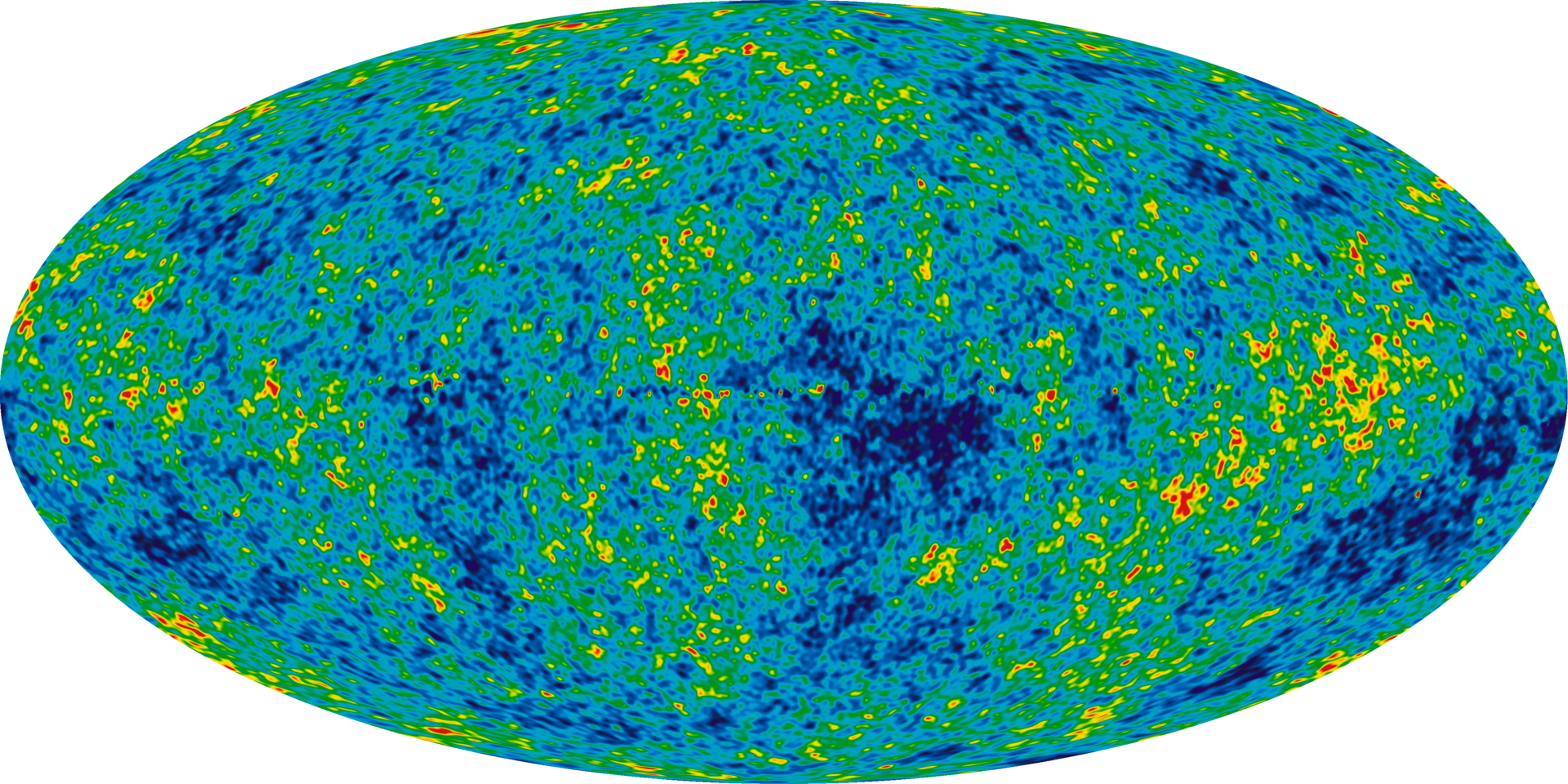
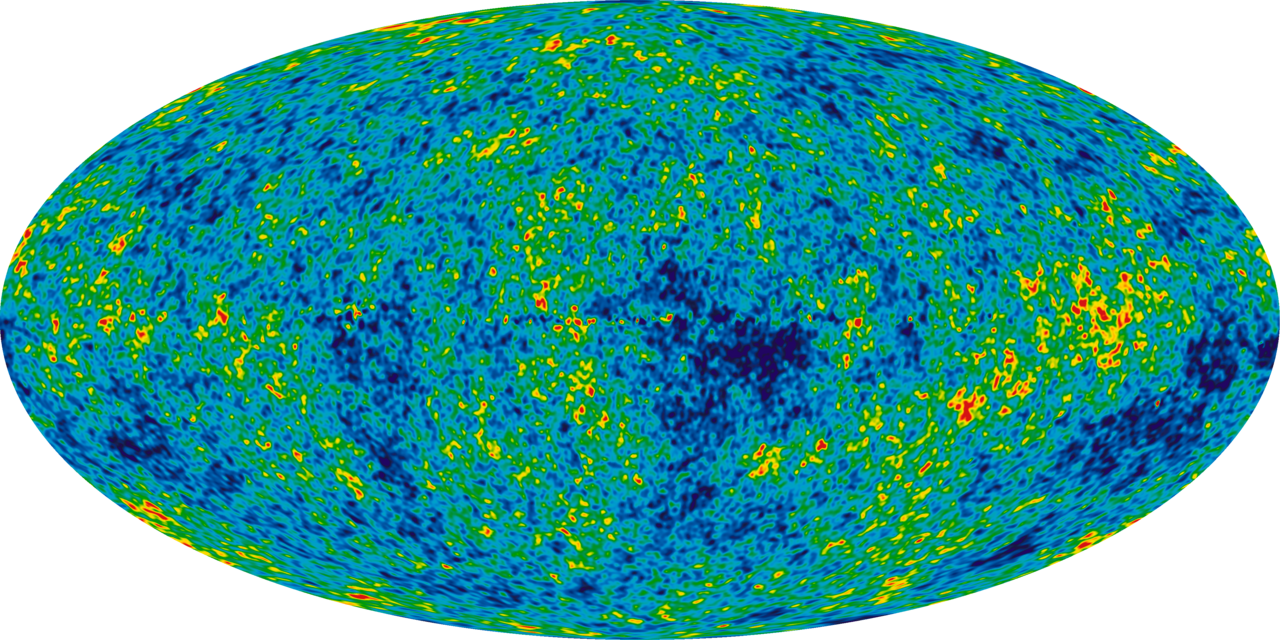
Cosmology is the deeper problem. The cosmic microwave background's pattern of fluctuations is fitted extremely well by a model with cold dark matter, and the relative heights of its acoustic peaks are difficult to reproduce without a non-interacting mass component. Structure formation across cosmic time, and the pattern of galaxy clustering, are similarly well described by the standard model.
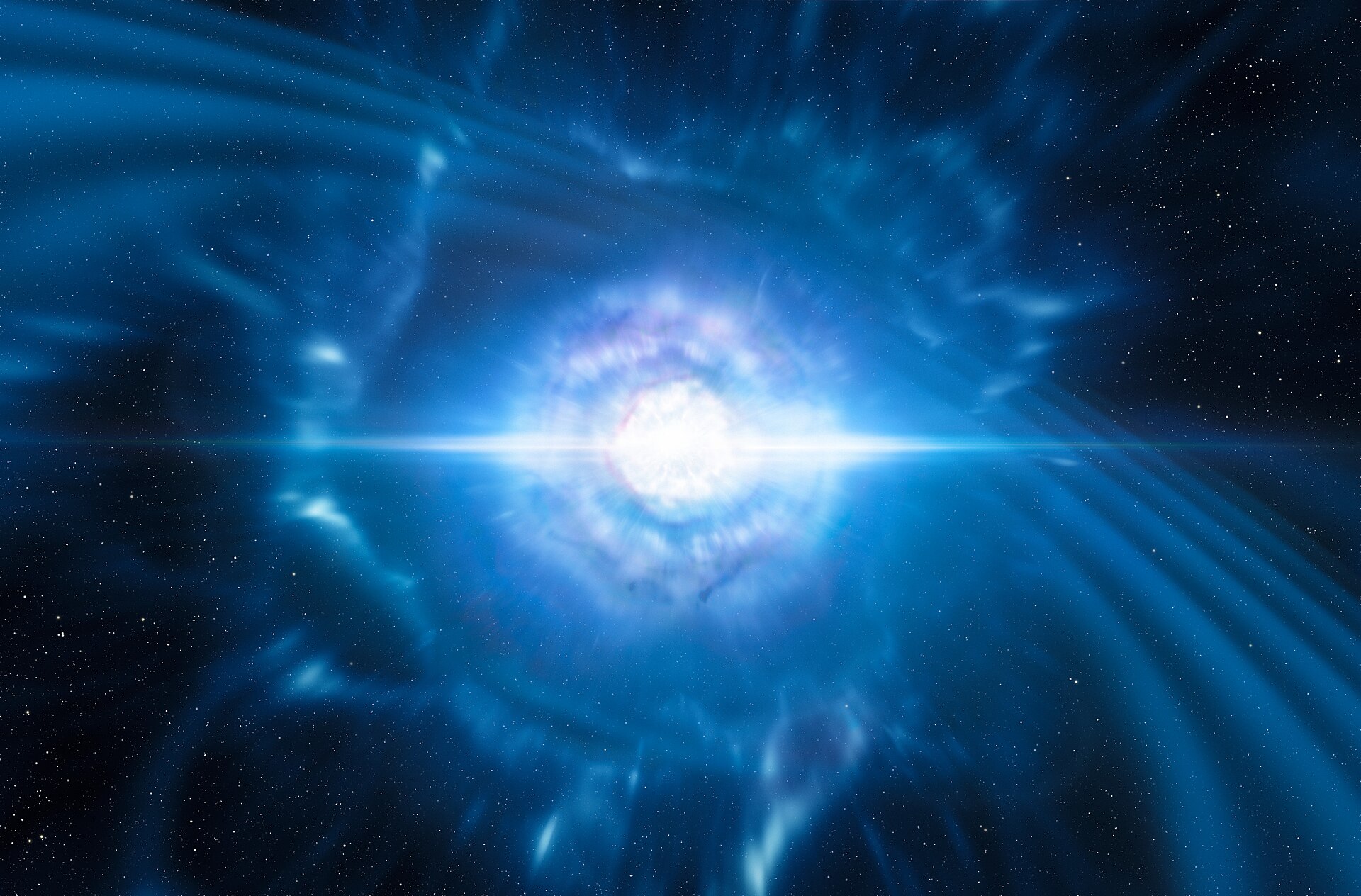
MOND in its original form is also non-relativistic, which makes it unable to address lensing or cosmology at all. Relativistic extensions exist, Jacob Bekenstein's TeVeS being the best known, and several have been constrained severely by the 2017 observation that gravitational waves and light from a neutron star merger arrived essentially simultaneously.
The mainstream position is that dark matter exists and MOND is wrong, and that position is supported by cluster and cosmological evidence.
The reason MOND has not disappeared is that its galaxy-scale successes are real and are not explained by the standard model. The radial acceleration relation in particular describes something that a lumpy, history-dependent halo has no obvious reason to produce, and accounting for it within simulations of galaxy formation remains an active problem rather than a solved one.
A defensible reading is that MOND is not the correct theory but is capturing a real empirical regularity that any correct theory of galaxy formation will have to reproduce. Its proponents accept that it is not a complete theory: it is a non-relativistic description of behaviour in the low-acceleration limit, and no relativistic version yet recovers general relativity, MOND and a workable cosmology together.
The dark matter MOND competes with has never been detected directly, and the searches are now running out of room in a specific and interesting way.
Liquid xenon detectors, principally LUX-ZEPLIN and XENONnT, have excluded weakly interacting massive particles across most of the mass range theory favoured, with results through 2025 extending the limits to lower masses without a detection.
More significant than another null result is what those detectors have started to see instead. LZ has now detected solar neutrinos through coherent scattering off xenon nuclei at high statistical significance. Neutrinos produce a signal essentially indistinguishable from the one a dark matter particle would produce, so this marks the arrival of what the field calls the neutrino fog: sensitivity is no longer limited by radioactive contamination or engineering noise, which can be improved, but by an irreducible background from the universe itself.
Detectors can still be built larger, and a next-generation instrument of around sixty tonnes is planned. But the era in which each generation gained orders of magnitude has ended, and the favoured candidate has not appeared.
This does not vindicate MOND, which fails at cluster and cosmological scales regardless. It does mean the standard model's central ingredient remains an inference from gravitational effects rather than something anybody has held in a detector, which is why a phenomenology that fits galaxies without it continues to be worth arguing about.