Any signal can be decomposed into a sum of pure sine waves of different frequencies. The claim was disbelieved when made, it is one of the most useful results in applied mathematics, and essentially all digital audio, imaging and communication depends on it.
Joseph Fourier introduced the idea in 1807 while studying how heat spreads through a solid.
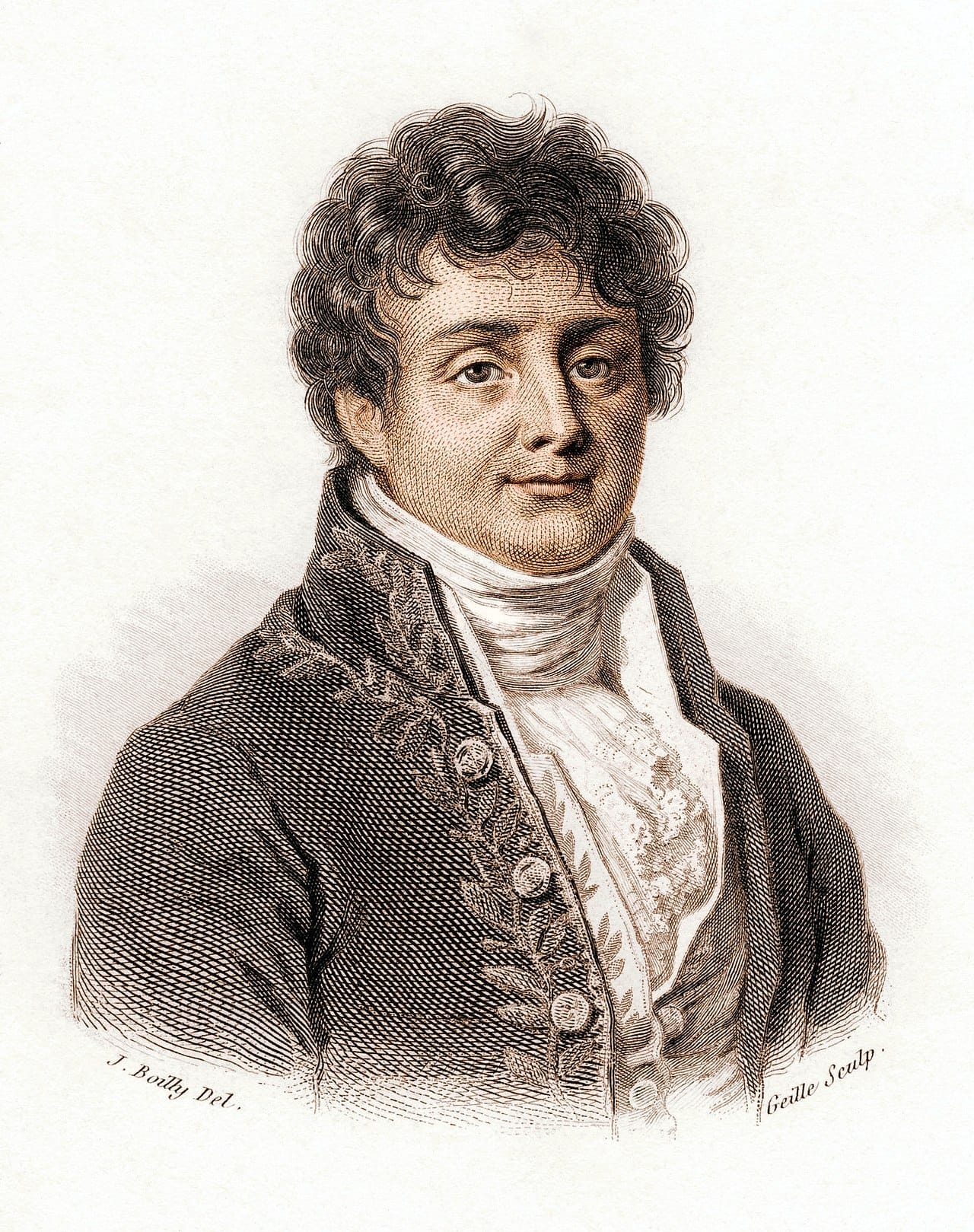
His proposal was that any function, including ones with corners and jumps, can be written as a sum of sines and cosines. This was received badly. Lagrange objected that a sum of smooth curves could not produce a sharp corner, and the objection sounds reasonable and is wrong: an infinite sum can, and the mathematics of exactly when it can occupied much of the nineteenth century.

The transform generalises the idea from periodic functions to arbitrary ones. It takes a function of time and returns a function of frequency, describing how much of each frequency is present. The operation is reversible: the inverse transform reconstructs the original exactly, so no information is lost. Time and frequency are two complete descriptions of the same thing.
The reason is narrower than "it decomposes signals" and worth stating precisely.
Many physical systems act on each frequency independently. A filter attenuates some frequencies and passes others. A medium delays each frequency by its own amount. A resonant system responds strongly at one frequency and weakly elsewhere.
In the time domain such effects are described by convolution, which is awkward. In the frequency domain they become simple multiplication. Transforming, multiplying, and transforming back turns a hard operation into an easy one, and this is the engine behind most signal processing.
Differential equations undergo the same simplification. Differentiation in time becomes multiplication in frequency, which converts a differential equation into an algebraic one. Fourier's original heat problem was solved this way, and the method is standard across physics and engineering.
Computing a transform on n samples directly requires a number of operations proportional to n squared, which is prohibitive for real data.
The fast Fourier transform reduces this to n log n by exploiting symmetries and computing the result recursively. For a million samples that is a speed-up of roughly fifty thousand times, which converts an impossible calculation into an instant one.
James Cooley and John Tukey published it in 1965, and it was then found that Carl Friedrich Gauss had described the same method in 1805, before Fourier's paper, in work that was published only posthumously and in Latin.
The algorithm is routinely called the most important numerical algorithm of the twentieth century, and the claim is defensible: without it, digital signal processing as it exists would not be feasible.
Audio compression works by transforming sound into frequency components, discarding those the ear cannot perceive, and storing the rest. This is what MP3 and its successors do, and the psychoacoustic model deciding what to discard is applied in the frequency domain.
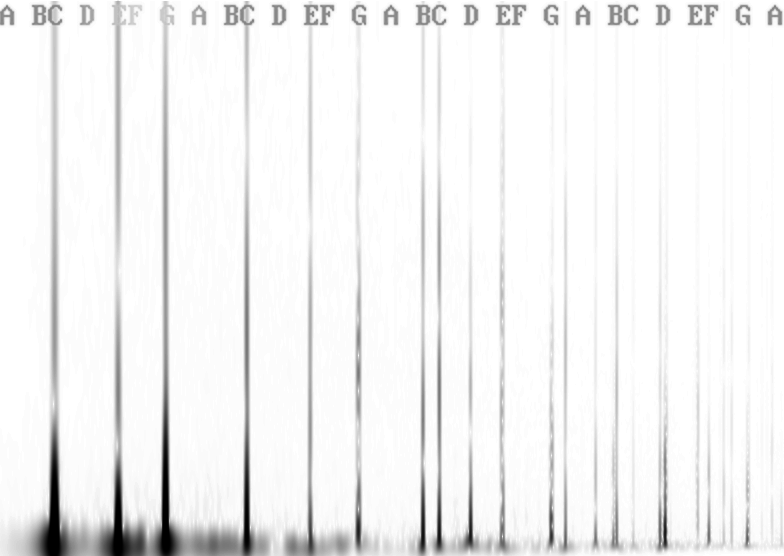
Image compression uses a close relative, the discrete cosine transform, on blocks of pixels. JPEG is this operation plus quantisation.
Magnetic resonance imaging measures signals in a domain that is literally the Fourier transform of the image, and reconstructing the picture is an inverse transform. Crystallography is the same relationship: a diffraction pattern is the transform of the electron density, which is why the phase problem in crystallography is a problem about transforms.
Radio and mobile communication encode data across many frequencies simultaneously, which is how Wi-Fi and mobile standards achieve their rates. Speech recognition begins by transforming audio into frequency content. Noise reduction identifies and removes frequency bands. Gravitational wave detection searches transformed data for the characteristic frequency sweep of a merger.
Time and frequency cannot both be known precisely. A signal confined to a short time necessarily contains a broad range of frequencies, and a pure frequency requires infinite duration.
This is a mathematical property of the transform, not a limitation of instruments. The same relationship, applied to position and momentum, is Heisenberg's uncertainty principle, which is why the principle is sometimes described as a fact about waves rather than a fact about quantum mechanics.
The practical consequence is that a spectrogram must trade time resolution against frequency resolution, and wavelet methods exist to manage that trade rather than escape it.