The sequence of changes in the species occupying a place over time after disturbance or after new ground appears. It is one of the oldest observations in ecology and its interpretation has changed substantially.
Primary succession begins on ground with no soil and no living remnant: bare rock exposed by a retreating glacier, a new lava flow, or a sand dune.
It is slow, because soil must be built. Lichens and mosses colonise bare rock, their acids and physical action break it down, and their remains accumulate as organic matter. Only once a thin soil exists can herbs, then shrubs, then trees establish. The process takes centuries to millennia.
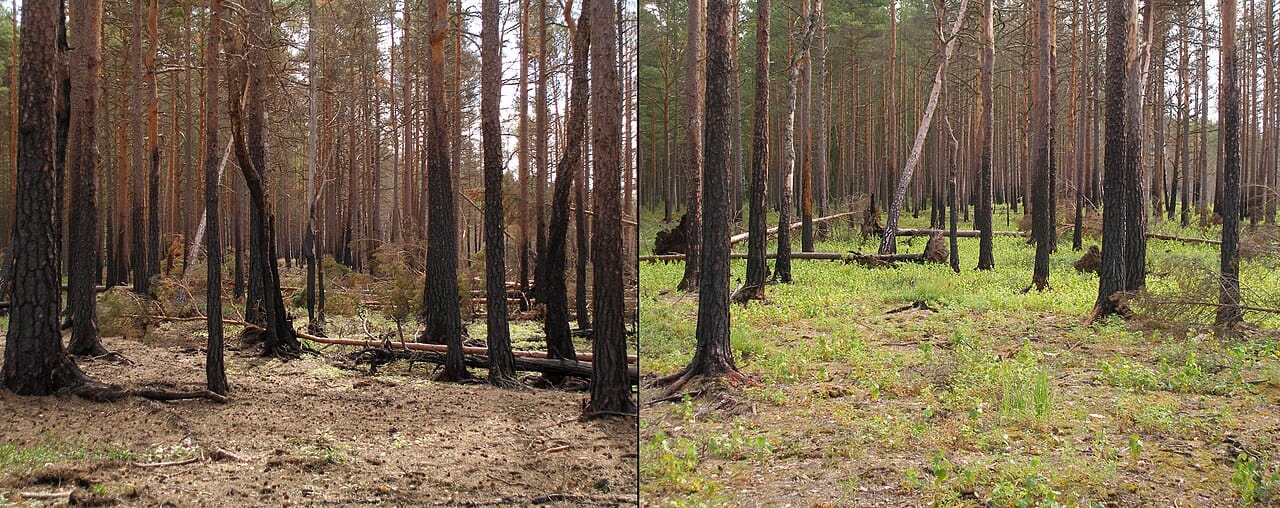
Secondary succession begins where a community has been disturbed but soil remains, as after fire, storm, flood or the abandonment of farmland.
It is far faster, because the soil, the seed bank, surviving roots and nearby sources are already present. A field abandoned in a temperate region typically passes through annual weeds, perennials, shrubs, fast-growing light-demanding trees and eventually shade-tolerant species over roughly a century.
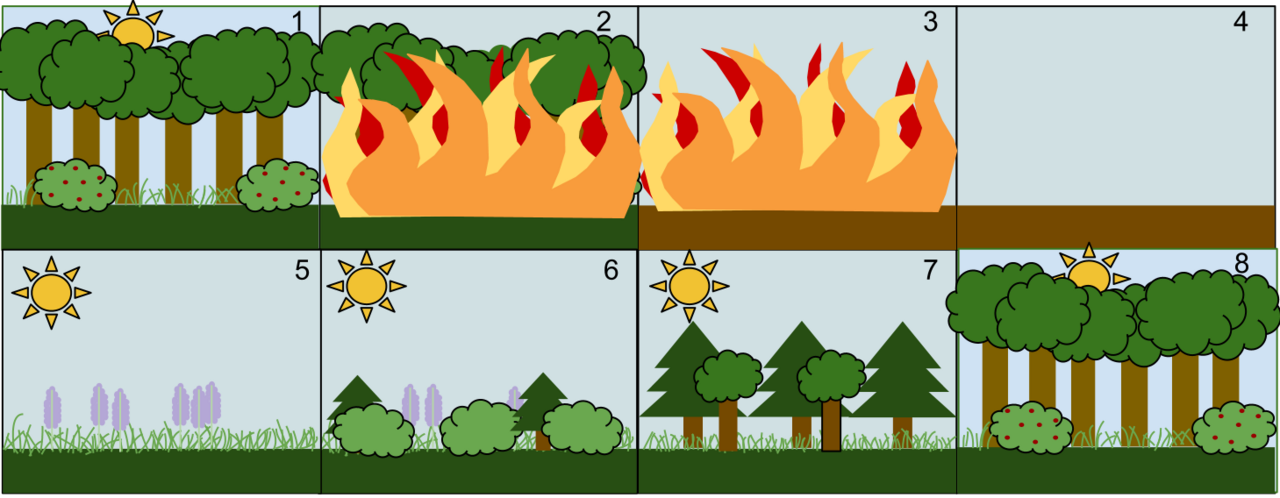
Succession is not merely random turnover, and the reason it proceeds in a general order is that occupants change the conditions.
Early colonists are typically fast-growing, produce many small dispersing seeds, tolerate exposure and demand light. They arrive first because they disperse well and grow quickly.
Their presence alters the site. They add organic matter, retain moisture, moderate temperature and cast shade. Those changes favour species that establish under shade and grow more slowly, which then outcompete the pioneers.
Three mechanisms have been distinguished. Facilitation, in which earlier species make conditions suitable for later ones. Tolerance, in which later species simply persist under conditions earlier ones can also survive, and eventually dominate because they live longer. Inhibition, in which occupants resist replacement and change occurs only when they are removed.
All three operate, and which dominates depends on the system, which is a more modest claim than the original theory made.
Frederic Clements proposed in the early twentieth century that succession proceeds deterministically toward a single stable endpoint, the climax community, determined by climate. He treated the community as something like a superorganism developing toward maturity.
Henry Gleason argued the opposite: that communities are assemblages of species that happen to tolerate the same conditions and arrive at the same place, with no collective organisation and no fixed endpoint.
The evidence has favoured Gleason. Species respond individually to conditions, community composition varies continuously across gradients rather than forming discrete units, and the endpoint depends on which species happen to arrive and in what order.
The concept of a single climax has therefore been largely abandoned. What replaced it is a picture in which succession has a general tendency, its outcome varies with initial conditions and chance, and mature communities are themselves patchworks of areas at different stages.
Disturbance is now treated as a normal component rather than an interruption. Many systems, including boreal forest, grassland and chaparral, depend on periodic fire, and suppressing it changes them fundamentally and allows fuel to accumulate.
The intermediate disturbance hypothesis proposes that diversity peaks at moderate disturbance frequency, since constant disturbance permits only pioneers and its complete absence allows dominant competitors to exclude others. It is influential and has been substantially criticised, with evidence that the pattern is not general.
Because succession takes longer than a career, most study uses a chronosequence: comparing sites of different known ages and treating the spatial series as a temporal one. Glacier forelands, where the date of ice retreat is known for each position, are the standard example.
The method assumes the sites differ only in age, which is not always true, and long-term monitoring plots have in several cases shown that the inferred sequence was wrong.
Long-running experiments, including abandoned field plots monitored for many decades, have provided direct evidence and have generally shown more variability between replicate plots than the classical theory expected.
Succession is the framework for ecological restoration. Knowing that a site will pass through stages determines whether intervention should plant a target community directly or establish the conditions for it, and attempts to skip stages frequently fail because the soil and shade conditions are not yet suitable.
It also underlies management of forests, grasslands and reserves, since holding a habitat at a particular stage requires deliberate disturbance, and a reserve left alone does not stay as it was when it was designated.