Copying a genome of three billion letters, at a final error rate of about one in a billion, in a few hours, every time a cell divides. The mechanism is understood in detail, and the accuracy comes from three separate stages of checking rather than from getting it right first time.
Watson and Crick's 1953 paper ends with a sentence noting that the pairing they had proposed immediately suggests a copying mechanism.
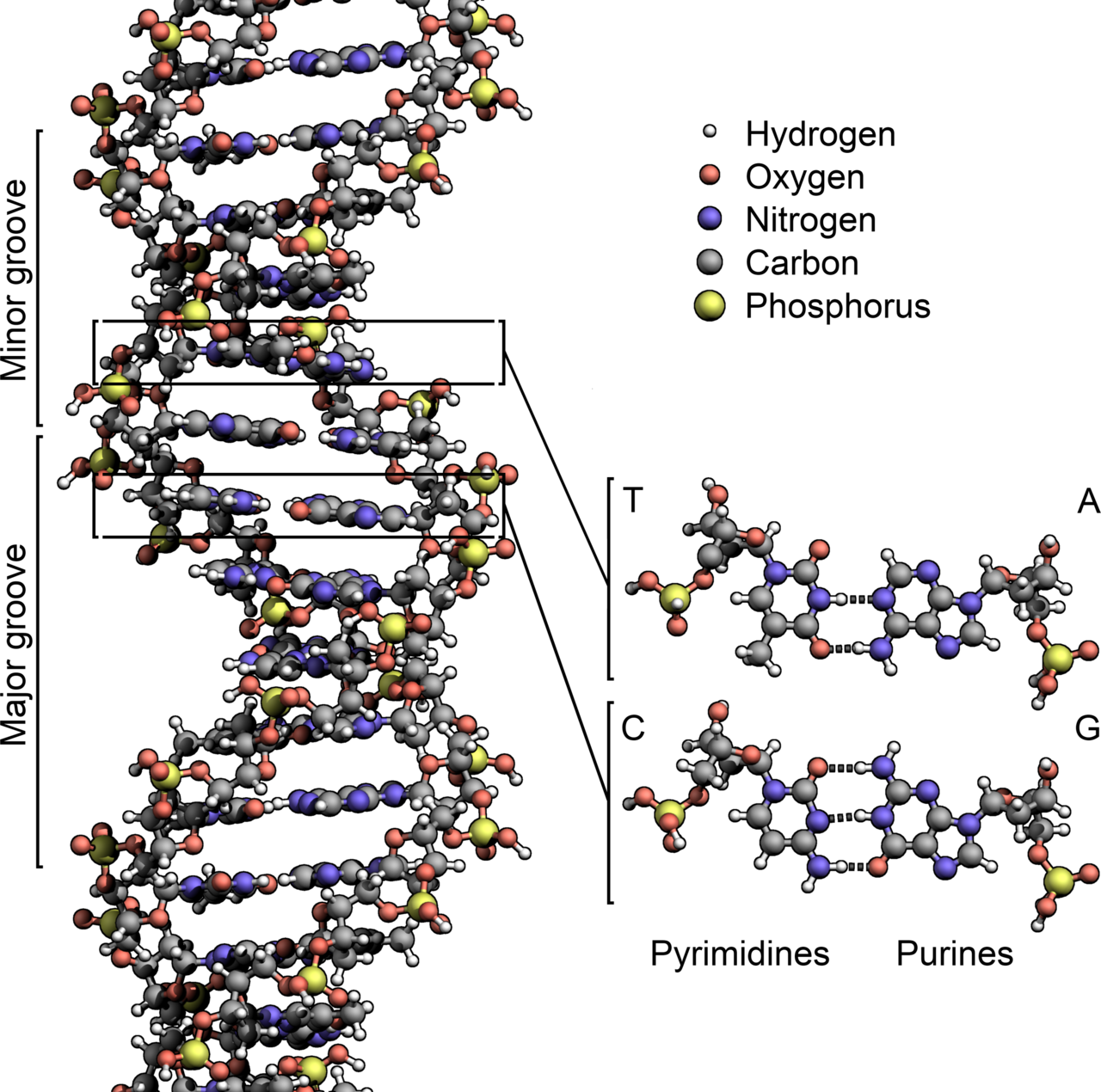
Because adenine pairs only with thymine and guanine only with cytosine, each strand specifies the other completely. Separate the two strands and each is a template for rebuilding its partner.
That is a prediction rather than an observation, and it was tested.
Three models were possible. Conservative: the original duplex stays intact and an entirely new one is made. Semiconservative: each new molecule has one old strand and one new. Dispersive: old and new material is interspersed.
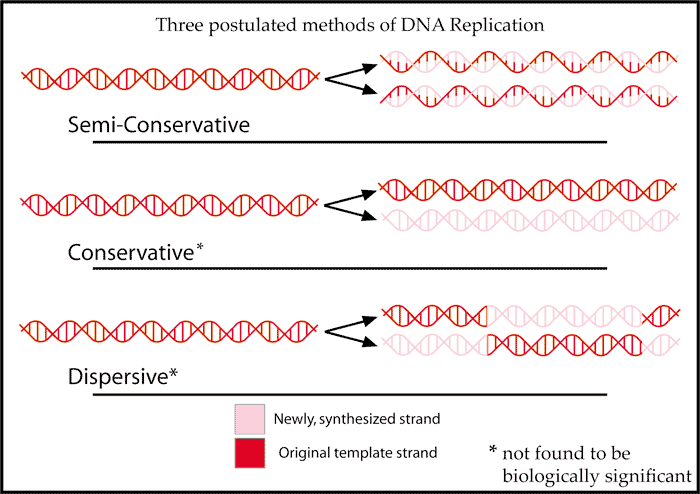
Matthew Meselson and Franklin Stahl distinguished them in 1958. They grew bacteria for many generations in a medium where the only nitrogen was the heavy isotope, so all the DNA was dense, then switched them to ordinary nitrogen and sampled after each division.
Spinning the DNA in a caesium chloride gradient separates it by density. After one generation all the DNA was of intermediate density, which rules out the conservative model. After two generations there were two bands, half intermediate and half light, which rules out the dispersive model.
The result is often called the most beautiful experiment in biology, and the reason is that it distinguishes three hypotheses cleanly with one measurement and no ambiguity.
Replication begins at specific origin sequences, one in a bacterial chromosome and many thousands in a human one, since a single origin could not copy a human genome in the available time.
Helicase unwinds the duplex. Single-strand binding proteins hold the separated strands apart. Topoisomerases relieve the supercoiling that unwinding creates ahead of the fork, which is a real mechanical problem: unwinding a long double helix at one point twists everything downstream.
DNA polymerase adds nucleotides, and it has two constraints that shape everything else. It can only extend an existing strand, never start one, so short RNA primers are laid down first by primase and later removed. And it can only work in one direction along the template.
Since the two strands run antiparallel, only one can be copied continuously. The other is copied backwards in short fragments, each requiring its own primer, which are then joined by ligase. This is why replication is described as having a leading and a lagging strand, and the fragments on the lagging strand are named for Reiji and Tsuneko Okazaki, who found them.
The final error rate is around one in a billion bases, and no single step achieves that.
Base pairing selectivity alone gives roughly one error in ten thousand. Polymerase proofreading, in which the enzyme reverses and removes a mismatched base before continuing, improves this to about one in ten million. Mismatch repair, a separate system that scans the new strand afterwards and corrects errors, gives the final figure.
Three independent stages, each catching most of what the previous one missed. This is the same engineering principle as error-correcting codes: reliability at the system level built from components that are individually unreliable.
Mismatch repair failure is not hypothetical. Inherited defects in it cause Lynch syndrome, one of the more common hereditary cancer predispositions, because an elevated mutation rate across a lifetime produces cancers at high frequency.
Linear chromosomes cannot be copied to their ends. Removing the final RNA primer on the lagging strand leaves a gap that no polymerase can fill, so chromosomes shorten with each division.
Telomeres, repetitive sequences at the ends, absorb this loss without destroying genes, and they shorten progressively. When they become too short the cell stops dividing, which is replicative senescence and one of the mechanisms limiting how many times a cell can divide.
Telomerase extends telomeres and is active in germ cells and stem cells and largely inactive in ordinary somatic cells. Most cancers reactivate it, which is part of how they escape the division limit. Elizabeth Blackburn, Carol Greider and Jack Szostak shared the 2009 Nobel Prize for this work.
Bacteria avoid the problem entirely by having circular chromosomes, which have no ends.