The mathematics of continuous change, comprising the differential calculus of rates and the integral calculus of accumulation, and the theorem stating that the two are inverse operations. It is the language in which physical law is written.
Differential calculus answers how fast something is changing at an instant. The difficulty is that speed is normally computed over an interval, and at a single instant the interval is zero, giving a meaningless ratio of nothing to nothing. The derivative resolves this by taking the limit as the interval shrinks toward zero without reaching it.
Integral calculus answers how much accumulates. The area under a curve is approximated by rectangles, and the approximation improves as the rectangles narrow; the integral is the limit of that process.
The fundamental theorem of calculus states that these are inverse operations: differentiation undoes integration and integration undoes differentiation. This is what makes the subject tractable, because an area can be found by reversing a rate rather than by summing infinitely many pieces.

The core ideas appeared repeatedly across many centuries before anyone unified them.
Archimedes computed areas and volumes in the third century BCE by the method of exhaustion, inscribing polygons with ever more sides. His approach to the area of a parabolic segment is an integration in all but name.
Ibn al-Haytham summed fourth powers in the eleventh century to find the volume of a paraboloid. Mathematicians of the Kerala school in southern India developed infinite series for sine, cosine and arctangent from the fourteenth century, including results equivalent to some later European series.
In seventeenth century Europe, Fermat found maxima and minima by a method close to differentiation, Cavalieri computed areas by indivisibles, and Isaac Barrow recognised the inverse relationship between tangent and area problems.
What was missing was not the individual techniques but a general system: notation, rules of manipulation, and the recognition that one method applied to all these problems.
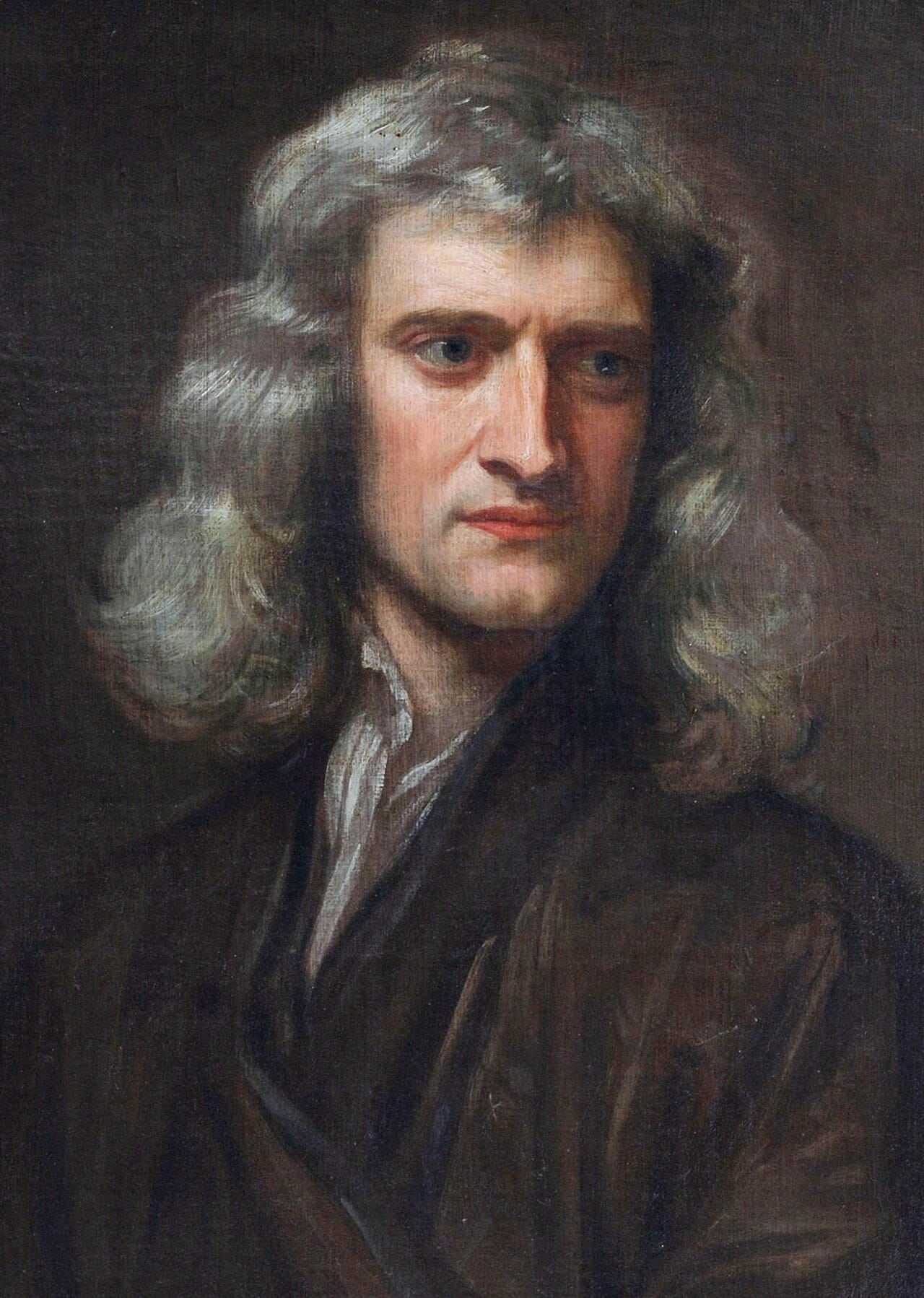
Isaac Newton developed his version from around 1665, calling it the method of fluxions, with quantities flowing in time and their rates of change as fluxions. He used it to show that an inverse square law of gravitation produces elliptical planetary orbits, which was the single most persuasive demonstration of the method's power. He was slow to publish.
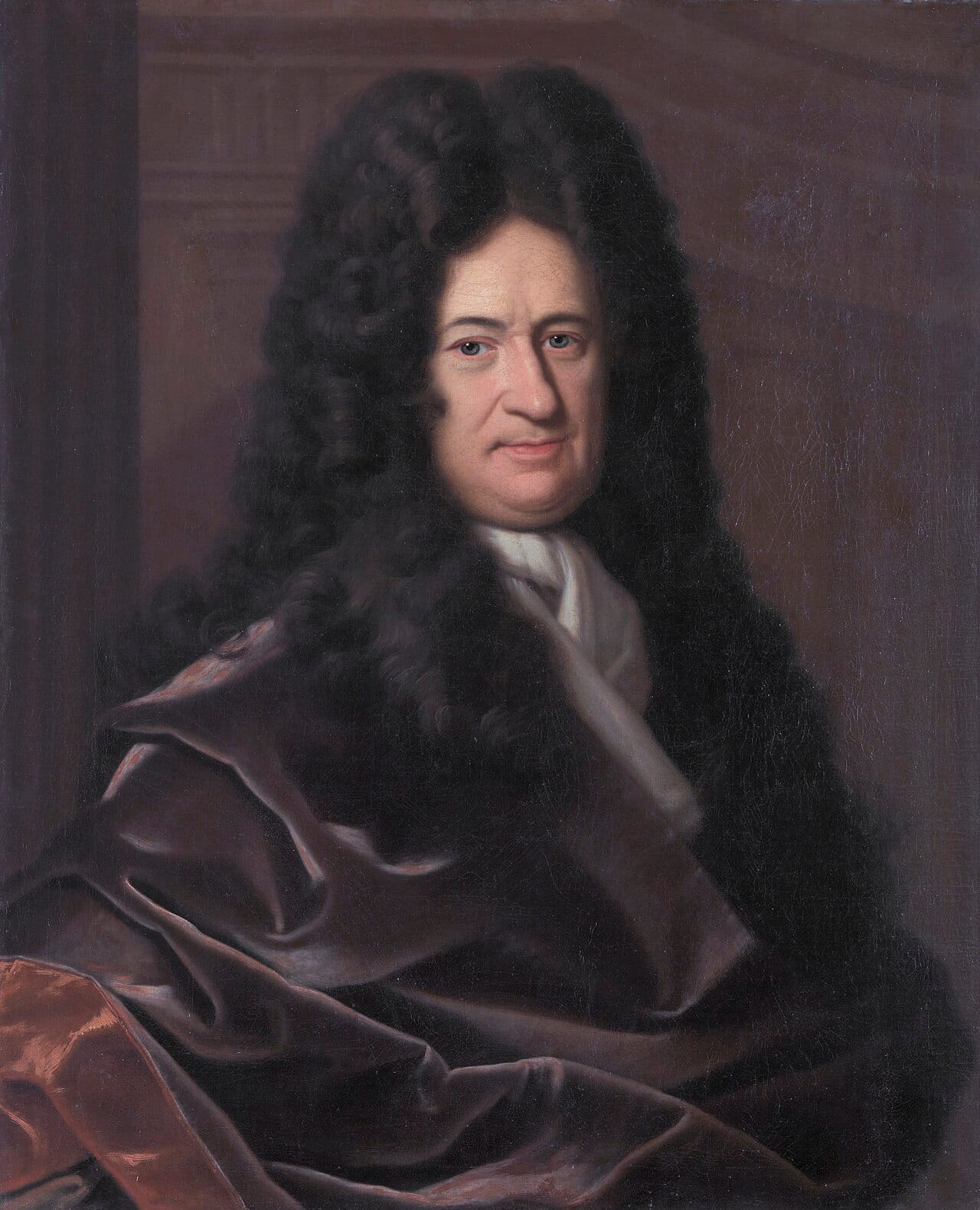
Gottfried Wilhelm Leibniz developed his version independently in the 1670s and published first, in 1684. His approach emphasised infinitesimals and, crucially, produced better notation.
Leibniz's notation is the one still in use. The elongated s for the integral, standing for summation, and the derivative written as one differential over another, are his. The notation is not merely cosmetic: it makes the chain rule look like cancelling fractions and makes substitution in integrals mechanical, so it guides correct manipulation.
The priority dispute that followed was bitter, ran for decades, and involved accusations of plagiarism in both directions. The modern judgement is that the two arrived independently. Its worst consequence was that British mathematics, loyal to Newton's notation, was cut off from continental developments for roughly a century.
Both versions rested on a shaky foundation. Infinitesimals were quantities treated as non-zero during a calculation and as zero at the end, which is inconsistent.
George Berkeley attacked this directly in 1734, describing the discarded quantities as the ghosts of departed quantities and pointing out that mathematicians objecting to theology on grounds of rigour were using reasoning they could not defend.
The objection was valid and took a century to answer. Augustin-Louis Cauchy and then Karl Weierstrass replaced infinitesimals with the precise definition of a limit, expressed in terms of arbitrarily small tolerances, which is the definition taught now. Abraham Robinson later showed in the 1960s that infinitesimals can be made rigorous after all, through non-standard analysis, vindicating the original intuition by a different route.
Physics is written in it. Newton's laws, Maxwell's equations, the heat and wave equations, general relativity and quantum mechanics are all differential equations, which are statements relating a quantity to its own rates of change.
Engineering uses it for structural analysis, fluid flow, control systems and signal processing.
Probability and statistics rest on integration, since a continuous distribution is defined by the area under its density.
Economics uses marginal analysis, which is differentiation applied to cost and utility, and optimisation, which is finding where a derivative is zero.
Machine learning trains models by gradient descent, adjusting parameters in the direction that most reduces error, which is a derivative computed across millions of parameters.
Before calculus, mathematics handled static relationships well and change badly. After it, the natural response to a physical question became writing down how a quantity changes and solving for the quantity, which is how nearly all quantitative science now proceeds. It also stands as the clearest case of a method being used successfully for a century and a half before anyone could say why it worked.