Behavioural economics is the study of how people actually make economic decisions, as opposed to how the standard model assumes they do. Its central finding is that departures from rational choice are systematic and predictable rather than random, which means they do not cancel out in aggregate and cannot be treated as noise.
Conventional economic models assumed a decision maker with stable preferences, unlimited computational capacity, and no emotional interference, choosing whatever maximises expected utility. This was understood as a simplification, defended on the grounds that errors would be random and would average out across many people.
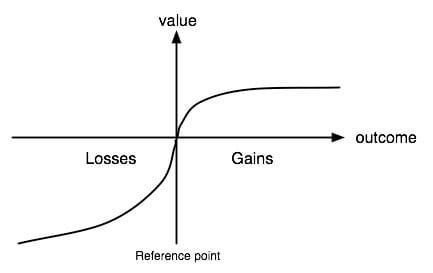
In 1979 Daniel Kahneman and Amos Tversky published prospect theory, showing that people evaluate outcomes as gains and losses relative to a reference point rather than as final states of wealth, and that losses weigh roughly twice as heavily as equivalent gains. The resulting value function is asymmetric, which explains why people take risks to avoid a loss that they would not take to secure a gain of the same size.
They and others documented a catalogue of systematic effects: anchoring, where an arbitrary number influences a later estimate; framing, where the same choice described as ninety per cent survival or ten per cent mortality produces different decisions; the endowment effect, where owning something raises its perceived value; and the availability heuristic, where easily recalled events are judged more likely.

Richard Thaler extended the work toward policy, arguing that small changes in how choices are presented, which he and Cass Sunstein called nudges, can substantially change outcomes without restricting anyone's options. Automatic enrolment in pension schemes, with an option to leave, raises participation dramatically compared with schemes people must actively join. Governments established behavioural units to apply such methods, and Thaler received the Nobel Prize in 2017.

Three arguments remain unsettled. The first is empirical: the replication crisis in psychology has affected this field, and several well known effects, including some priming results and aspects of ego depletion, have failed to replicate at their original strength. Loss aversion and anchoring have held up better than others, but the size of many effects has been revised downward.
The second concerns interpretation. Gerd Gigerenzer and others argue that many so-called biases are efficient heuristics that perform well in the environments where they evolved, and appear irrational only against an artificial laboratory standard. On this view the field has mistaken adaptation for error.
The third is ethical. If a choice can be steered by presentation, someone must decide the presentation, and critics ask by what authority and toward whose conception of the person's interest. Defenders note there is no neutral option, since every arrangement of choices influences behaviour, so the only question is whether the influence is deliberate and disclosed.