The account of why some solids conduct electricity and others do not, in terms of allowed and forbidden ranges of electron energy created by the periodic arrangement of atoms in a crystal. It is the foundation of semiconductor electronics.
Electrical conductivity varies across materials by more than twenty orders of magnitude, a range unmatched by any other common physical property. Copper and quartz are both dense solids of ordinary atoms, and one conducts while the other does not at all.
Classical physics could not supply an answer. The free electron model of Paul Drude and Hendrik Lorentz explained metallic conduction reasonably well but gave no reason why any solid should fail to conduct, and it predicted an electronic heat capacity far larger than measured.
The resolution came from applying quantum mechanics to an electron in a periodic array of ions.
Felix Bloch showed in 1928 that the wavefunction of an electron in a perfect periodic potential takes the form of a plane wave modulated by a function with the lattice's periodicity. The immediate consequence is that such an electron is not scattered by the lattice at all: a perfectly periodic solid offers no resistance, and real resistance comes from departures from periodicity, meaning thermal vibration, impurities and defects. This explains at once why metal resistance falls as temperature falls and why purity matters.
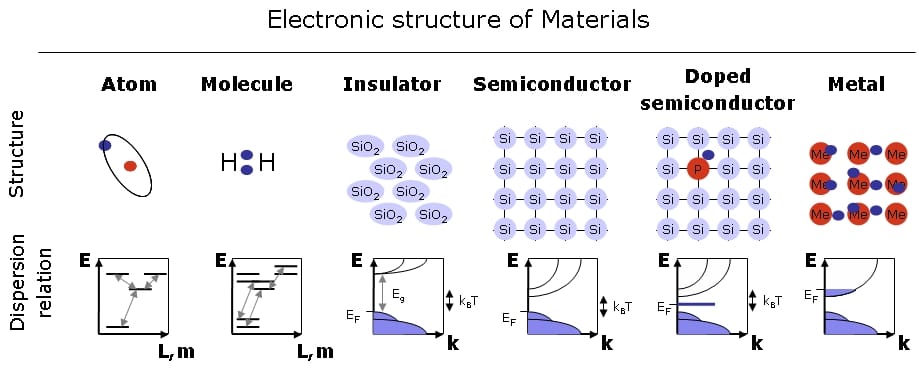
Solving for allowed energies gives the central result. Electron energies fall into continuous bands separated by gaps in which no state exists. The bands can be seen as arising from atomic levels: bring many atoms together and each atomic level splits into as many closely spaced levels as there are atoms, forming a near-continuum.
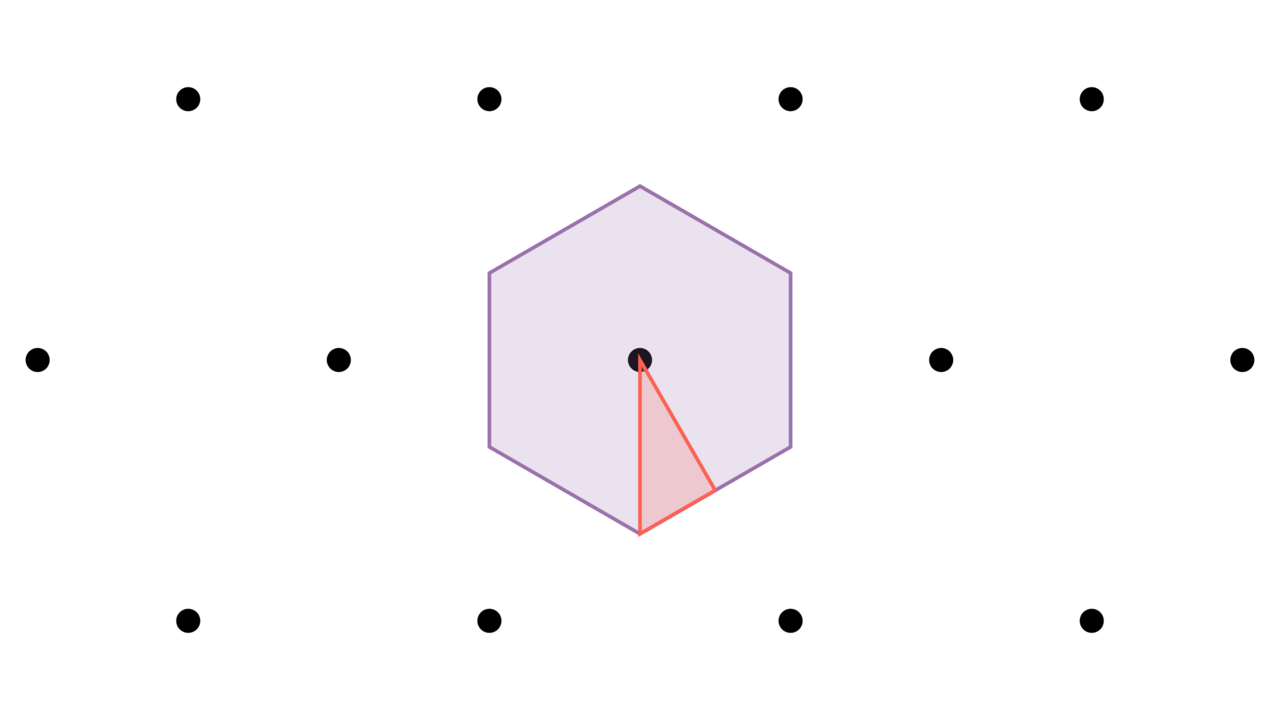
Because electrons are fermions, they fill the available states from the bottom up, and the energy of the highest filled state at absolute zero is the Fermi level. Everything then depends on where the Fermi level falls.
If it lies inside a band, there are empty states immediately above the filled ones, electrons can be accelerated by a field, and the material is a metal. If it falls in a gap, an electron must acquire the full gap energy before it can move, and the material is an insulator or, if the gap is small enough for thermal excitation to matter, a semiconductor. Alan Wilson made this identification in 1931, and it is the point at which the theory became an explanation rather than a formalism.
Diamond and silicon differ in exactly this way and in almost nothing else: both are group IV elements in the same crystal structure, and the difference between an insulator and a semiconductor is a gap of about 5.5 electronvolts against about 1.1.
The theory's predictions are directly measurable and they hold.
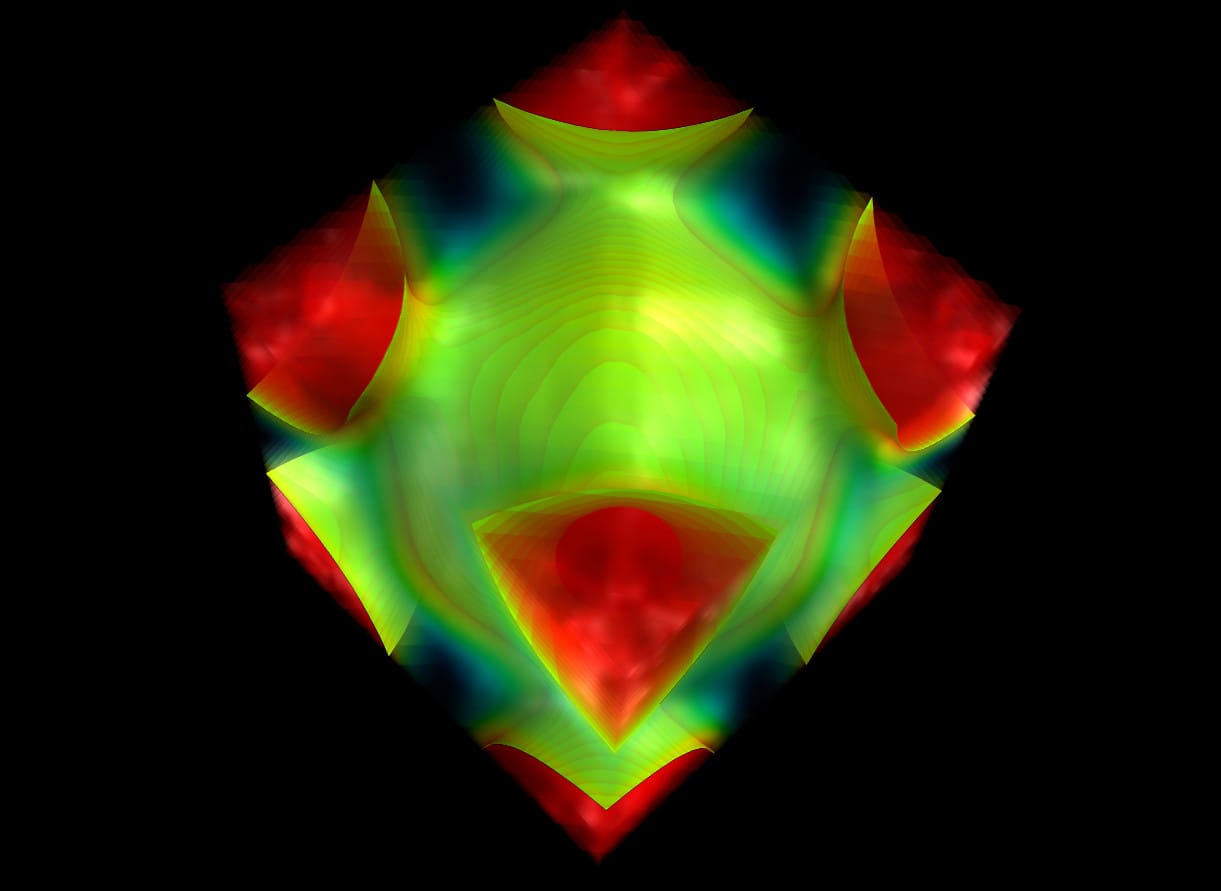
Fermi surfaces, the boundary in momentum space between occupied and empty states, are predicted in detail and are measured by the de Haas van Alphen effect, by positron annihilation and by angle-resolved photoemission. The distinctive necked shape of copper's Fermi surface is a band theory prediction confirmed by experiment.
Optical absorption edges occur at the predicted band gap energies, which is why silicon is opaque to visible light and transparent in the infrared, and why the gap can be read off an absorption spectrum.
The distinction between direct and indirect gaps has an unmistakable practical signature. In silicon the band minimum and maximum sit at different momenta, so light emission requires a phonon as well, making silicon a poor light emitter. Gallium arsenide has a direct gap and emits efficiently, which is why light emitting diodes and laser diodes are not made of silicon.
Doping, treated in its own capsule, works exactly as the theory requires: adding atoms with one more or one fewer valence electron places states just inside the gap and moves the Fermi level toward one band or the other.
Band theory in its standard form treats each electron as moving in an average potential produced by all the others, and that approximation fails when electron interactions are strong.
The clearest failures are the Mott insulators. Several transition metal oxides have a partly filled band, which band theory says must make them metals, and they are insulators, because the energy cost of putting two electrons on the same site exceeds the energy gained by delocalising them. Nickel oxide is the standard example.
This is not a marginal exception. The copper oxide superconductors are doped Mott insulators, and the difficulty of describing them is a large part of why their superconductivity is still unexplained, as the BCS theory capsule sets out.
Amorphous and disordered solids also fall outside the original framework, since it assumes perfect periodicity, and required the separate development of ideas about localisation.
Band theory is the reason semiconductor engineering is a design discipline rather than a search: gaps, effective masses and carrier concentrations can be calculated and engineered. It also demonstrates something general about condensed matter, which is that the collective arrangement of atoms creates properties belonging to no individual atom.