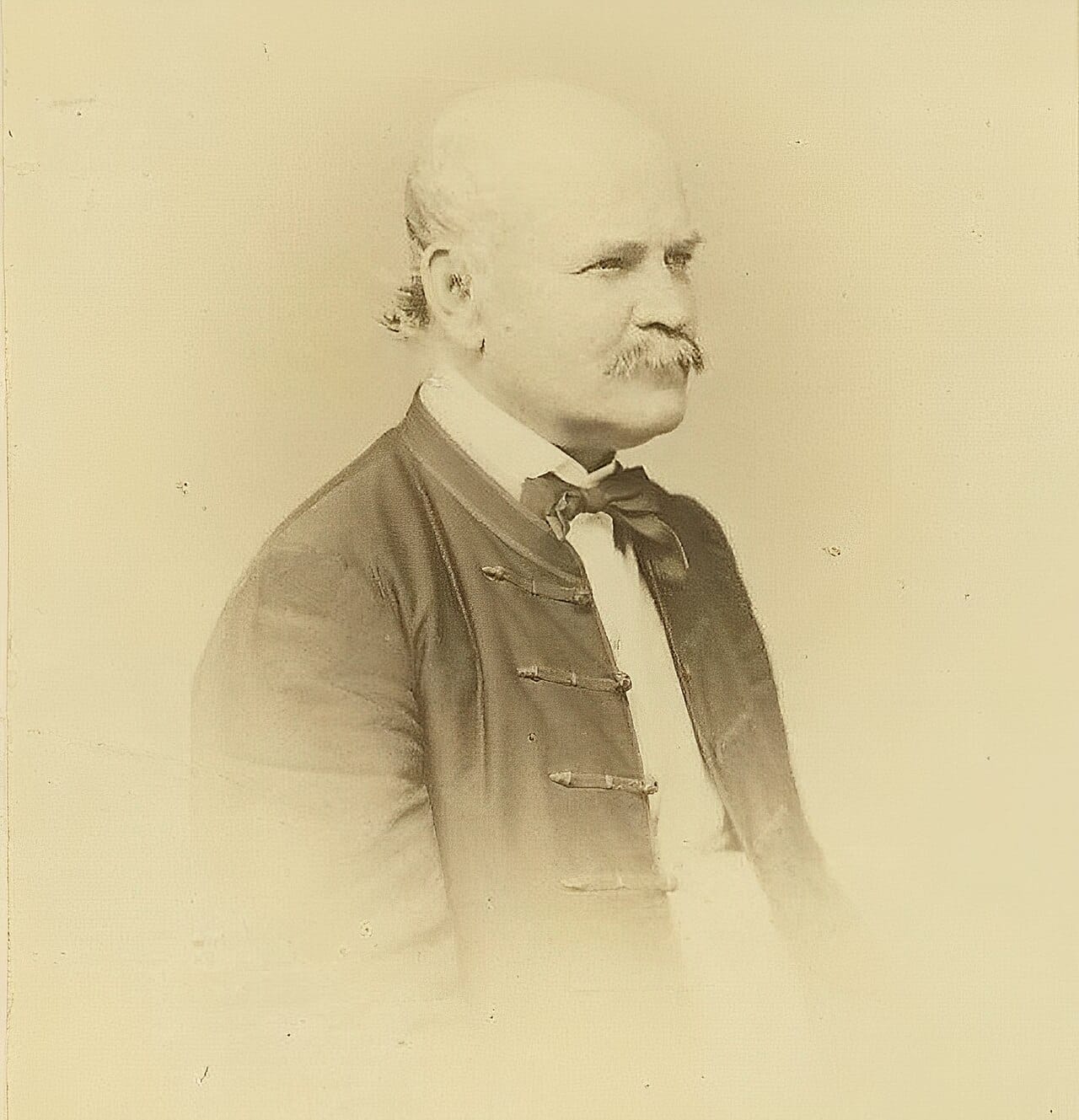
A Hungarian obstetrician worked out in 1847 that doctors were killing women in childbirth by carrying something on their hands from the dissection room. He proved it by measurement, cut deaths by around ninety percent, and was rejected, dismissed and committed to an asylum, where he died.
The Vienna General Hospital had two maternity clinics, and admission alternated by day.
The first clinic, staffed by doctors and medical students, had maternal mortality from puerperal fever of around ten percent, reaching eighteen in bad months. The second, staffed by midwives, ran at around four.
The difference was public knowledge. Women begged to be admitted to the second clinic and some gave birth in the street rather than enter the first, and street births had lower mortality than the doctors' clinic, which Semmelweis noted as a fact requiring explanation.
He worked by elimination, and the reasoning is a model of the method.
The clinics shared climate, overcrowding and the same population of women, so those were excluded. Religious practice differed and he changed it, with no effect. Delivery position differed and he changed it, with no effect.
The answer came from a death. Jakob Kolletschka, a colleague, was cut by a student's scalpel during an autopsy and died with the same clinical picture as the women. Semmelweis concluded that something transmitted from cadavers caused the disease, and that the doctors were carrying it: they performed autopsies each morning and went directly to deliveries. The midwives did no autopsies.
He had no germ theory. He called the agent cadaverous particles, which is wrong in detail and exactly right in its practical implication.
In May 1847 he required hands to be washed in chlorinated lime solution, chosen because it removed the smell of the dissection room, which he took as evidence it removed the material.
Mortality in the first clinic fell from around eighteen percent in April to about two by June, and to near one percent thereafter. It fell to match the midwives' clinic and stayed there.

He later showed the same effect for instruments, after an outbreak traced to a case of infected discharge rather than a cadaver, which extended his account from corpses to any decomposing organic material.
The profession did not accept it, and the reasons are not simply stupidity.
The claim was insulting. It said that doctors were killing their patients, and that the more diligent ones who attended autopsies were killing more.
It had no mechanism. Germ theory was two decades away, and cadaverous particles explained nothing about how a particle caused disease. Prevailing theory attributed illness to miasma or to imbalances in the individual patient, and a doctrine of individualised causes made a single universal cause implausible.
And Semmelweis handled it badly. He delayed publishing for fourteen years, relying on others to spread the finding, and when he finally wrote his book in 1861 much of it was aggressive. He sent open letters to prominent obstetricians calling them irresponsible murderers. This did not help, and it is the part usually left out of the story.
His contract in Vienna was not renewed in 1849. He returned to Hungary, reduced mortality at a hospital in Pest to under one percent, and was still disregarded. In 1865, his behaviour having deteriorated, he was committed to an asylum by colleagues, beaten by guards, and died two weeks later of an infected wound.

Louis Pasteur established germ theory in the 1860s and identified streptococci in puerperal fever cases in 1879. Joseph Lister introduced antiseptic surgery in 1867, having read Pasteur rather than Semmelweis.
The Semmelweis reflex now names the reflexive rejection of evidence that contradicts an established position, and the case is cited constantly in that sense.
It is worth citing carefully. The lesson is not that consensus is usually wrong, since it usually is not, nor that any rejected claim is Semmelweis. The lesson is narrower: he had a controlled comparison, an intervention, and a measured outcome, and that was rejected because it lacked a mechanism and offended its audience. Evidence of that quality should move a position whether or not the explanation is available yet.
Hand hygiene compliance in hospitals remains a measured problem today, frequently below fifty percent without active intervention, which is a more uncomfortable postscript than the historical injustice.