Saint Kitts and Nevis is a two-island nation in the Leeward Islands of the eastern Caribbean, the smallest sovereign state in the Americas by both area and population. Made up of the larger island of Saint Kitts and the smaller, near-circular Nevis, it was one of the first islands in the region to be colonised by the English and the French, earning Saint Kitts the nickname the mother colony of the West Indies. A former sugar economy built on enslaved labour, it is today a tourism and offshore-finance nation, and the birthplace of the American founding father Alexander Hamilton.
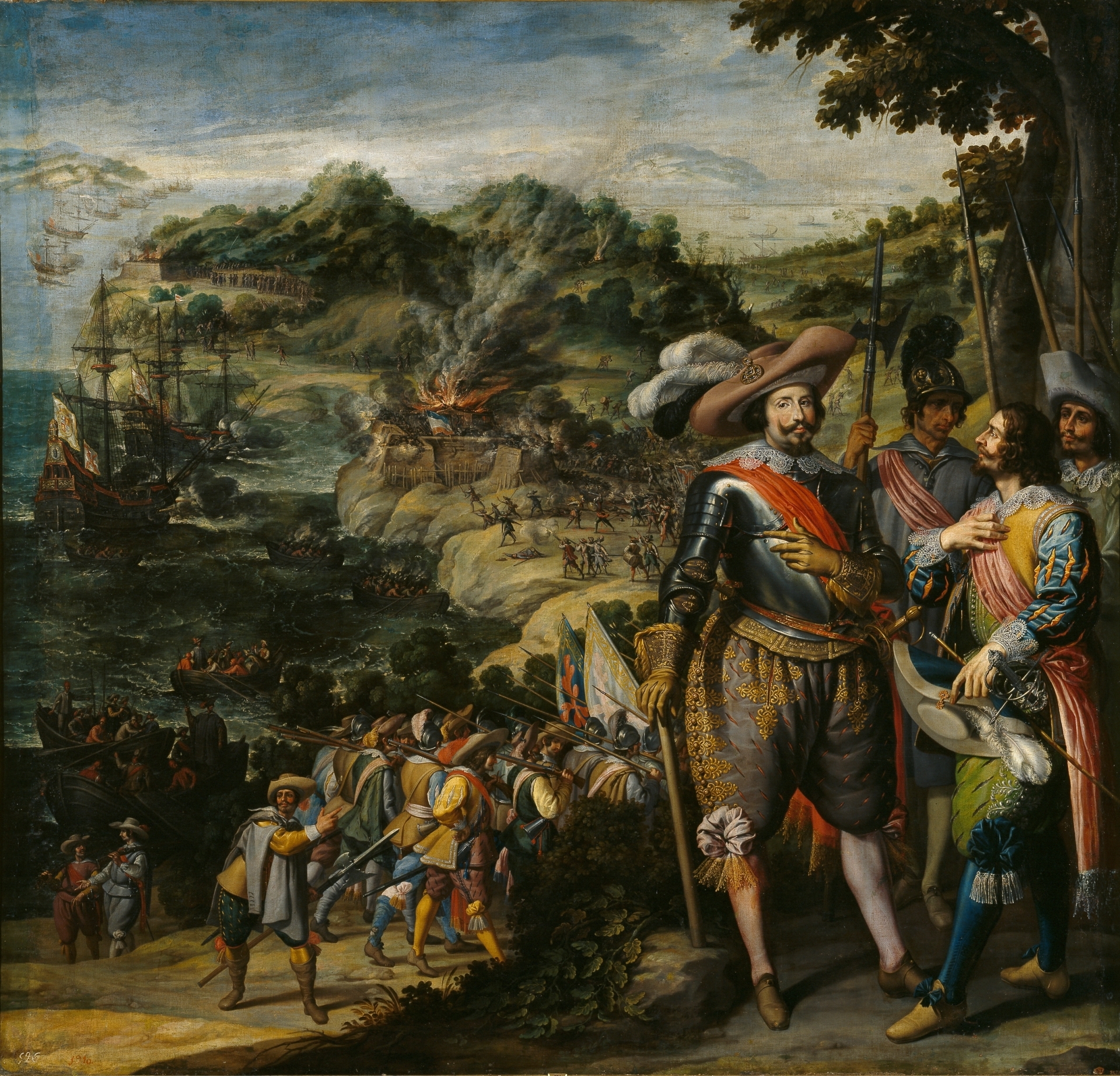
The Kalinago called Saint Kitts Liamuiga, fertile land. The English settled in 1623 and the French joined them in 1625, dividing the island between them, and from this one small place both powers went on to colonise much of the eastern Caribbean, which is why Saint Kitts is called the mother colony of the West Indies. The partnership began with an atrocity: in 1626 the two European groups combined to massacre the Kalinago population at Bloody Point, forestalling a rising they believed was planned. Spain briefly expelled both in 1629. Thereafter England and France shared, disputed, and fought over the island until Britain took it entirely in 1713.
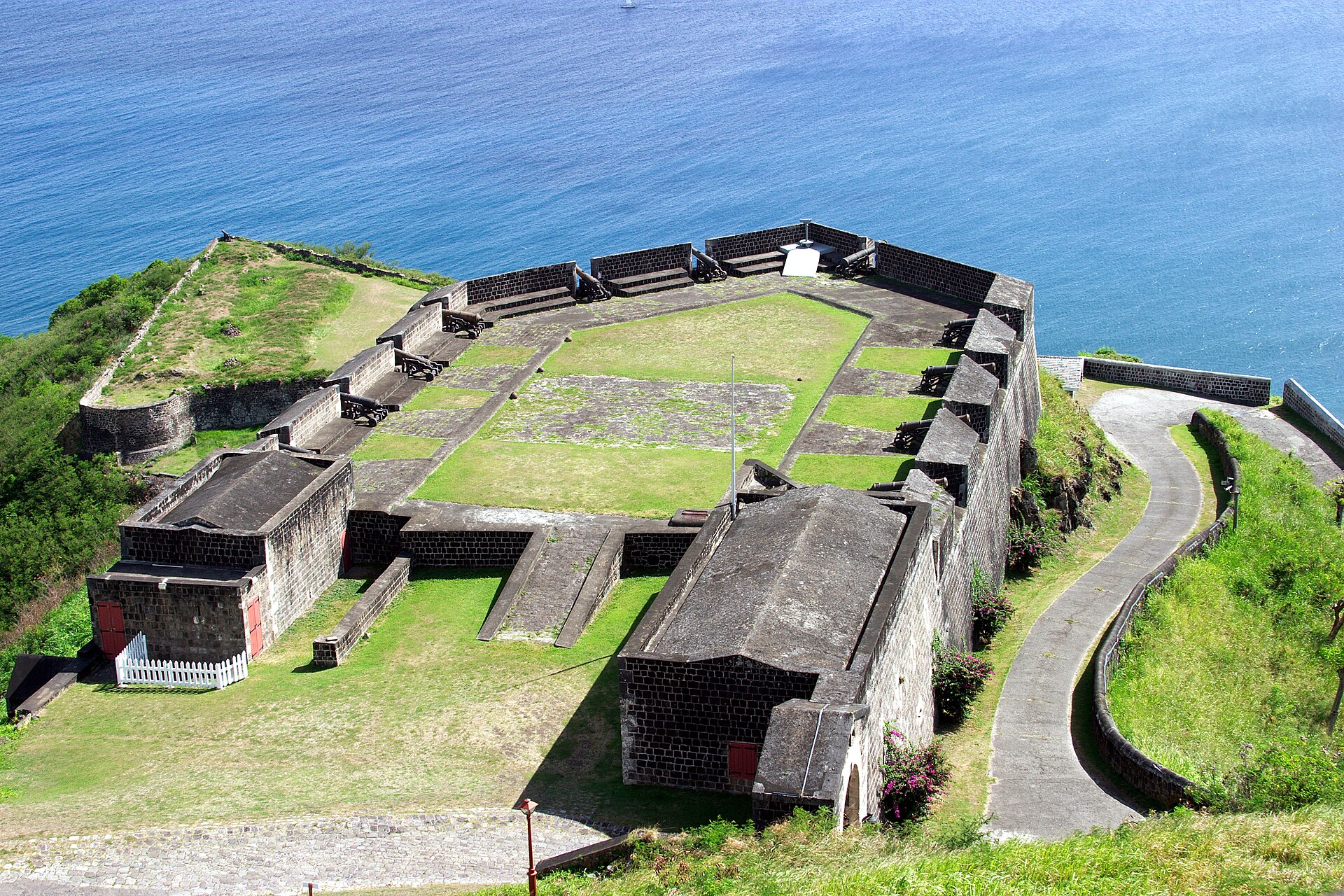
Sugar made it extraordinarily valuable, and the enslaved population brought from Africa came vastly to outnumber the free. The fortress on Brimstone Hill, built by enslaved labour over roughly a century on a volcanic outcrop 250 metres above the sea, was called the Gibraltar of the West Indies and is now a World Heritage site. Its scale is the clearest measure of what the sugar was worth.
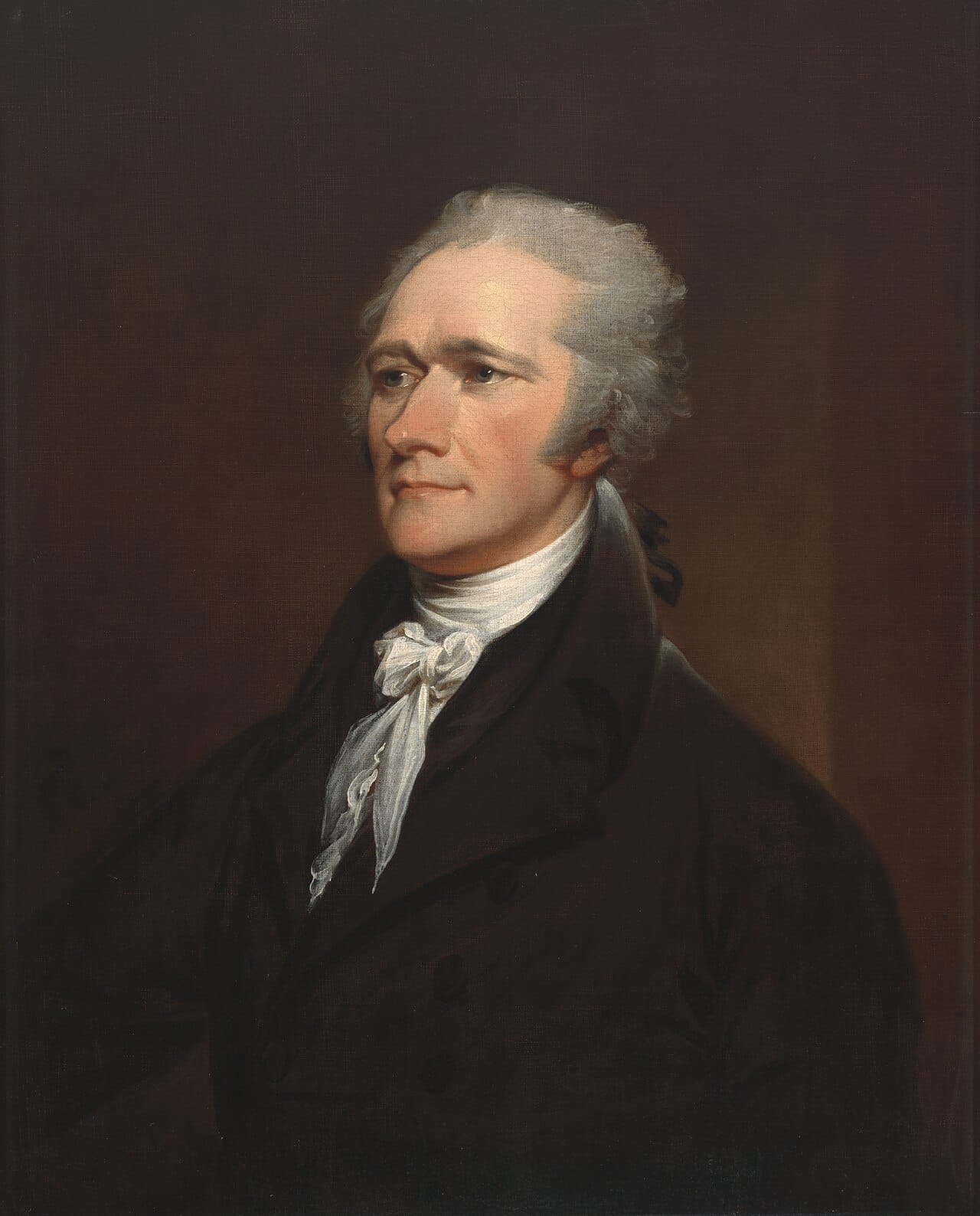
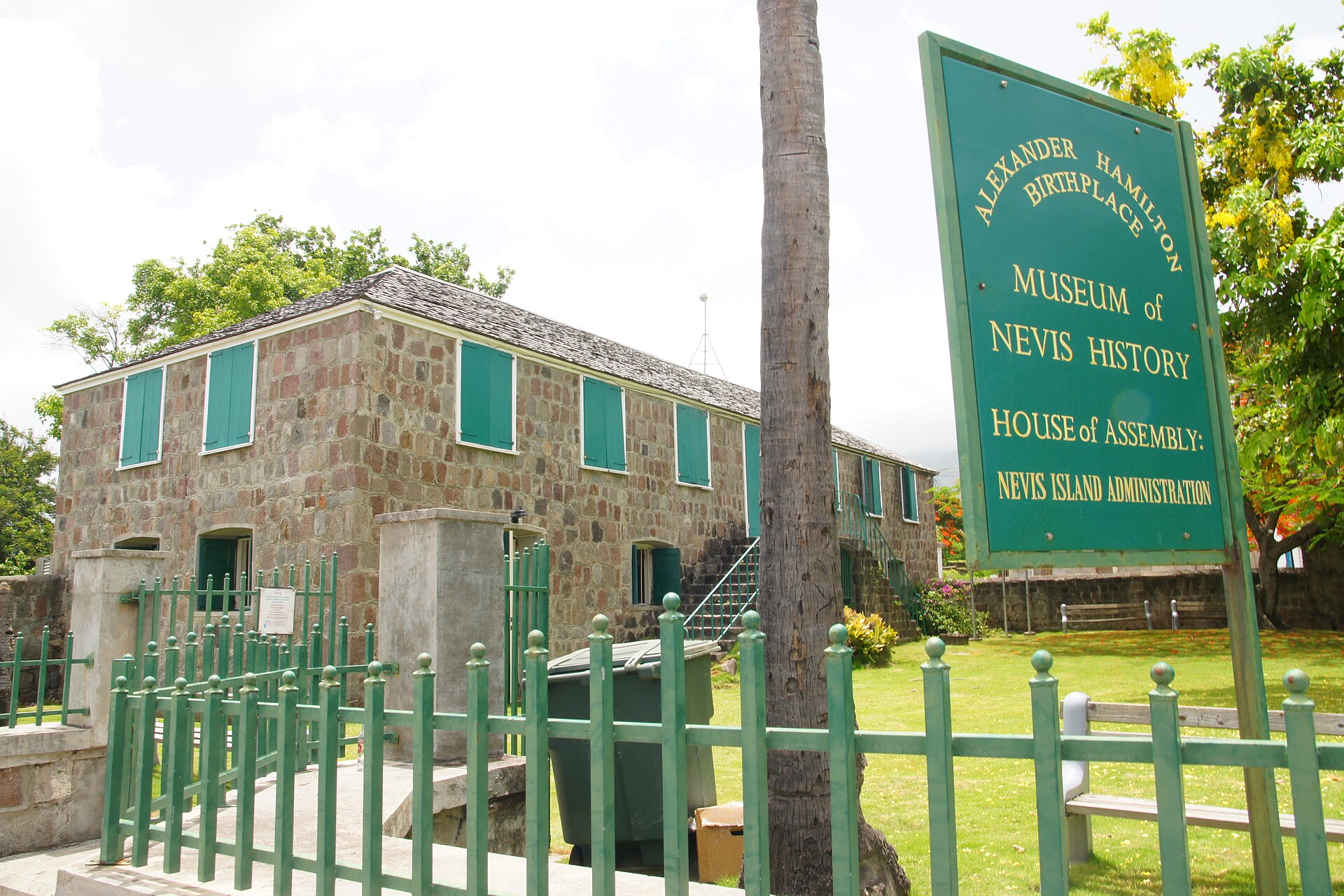
Nevis, smaller and once wealthier per head than its neighbour, was a sugar island and a spa resort where planters took the waters. Alexander Hamilton was born in Charlestown around 1755, the illegitimate son of a Scottish trader, and spent his early years there and on St Croix before a subscription raised by local merchants sent him to New York, where he became an author of the Federalist Papers and the first United States Treasury Secretary. His birthplace is now the Nevis museum. Horatio Nelson married Frances Nisbet on Nevis in 1787.
Emancipation came in 1834. Sugar continued as the mainstay far longer than elsewhere, with the industry nationalised after independence and finally closed only in 2005, ending three and a half centuries of cane. The islands, together with Anguilla, moved to associated statehood in 1967; Anguilla objected to being governed from Basseterre, revolted, and eventually returned to British rule. Saint Kitts and Nevis became independent on 19 September 1983, the last Caribbean territory to do so.
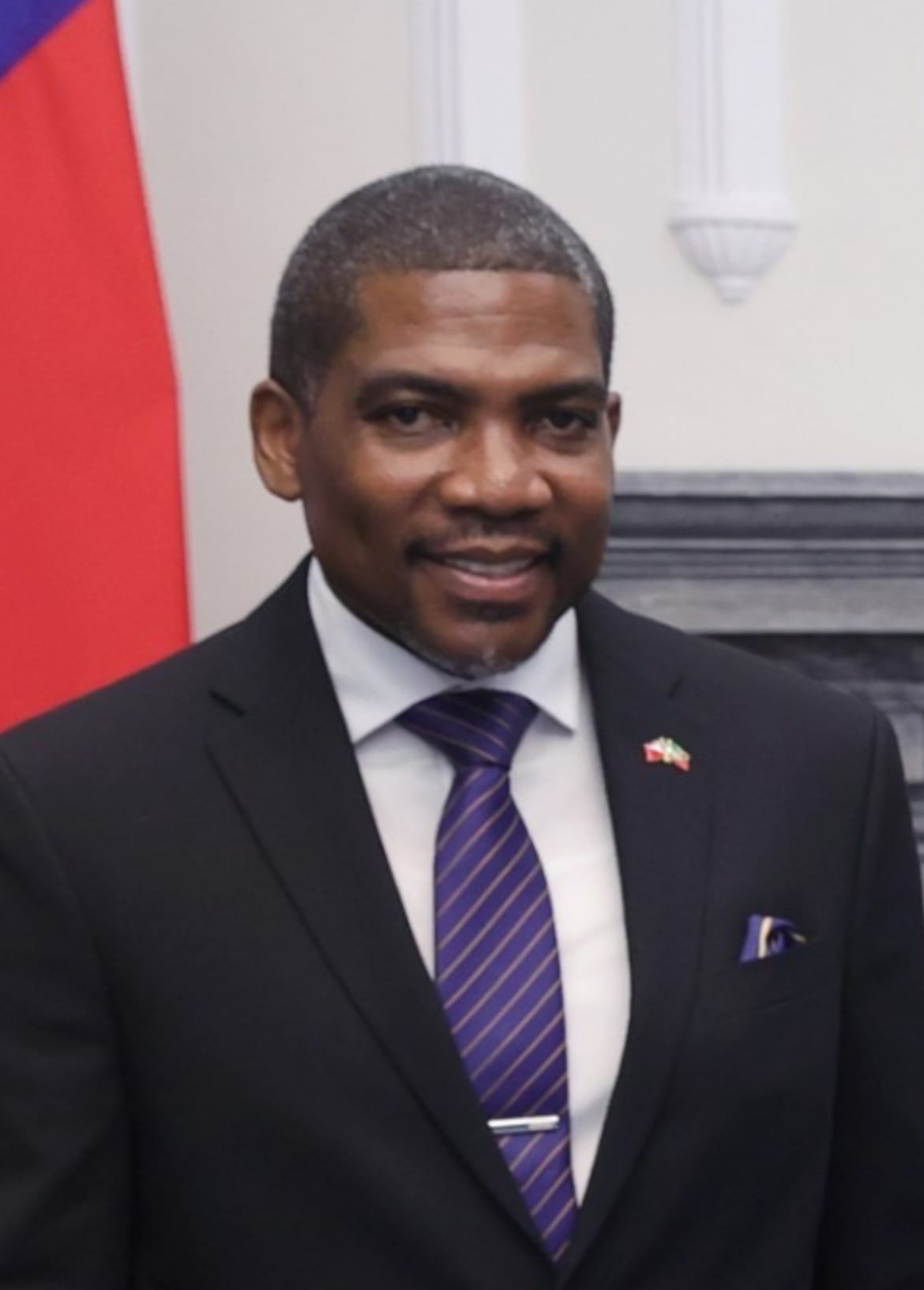
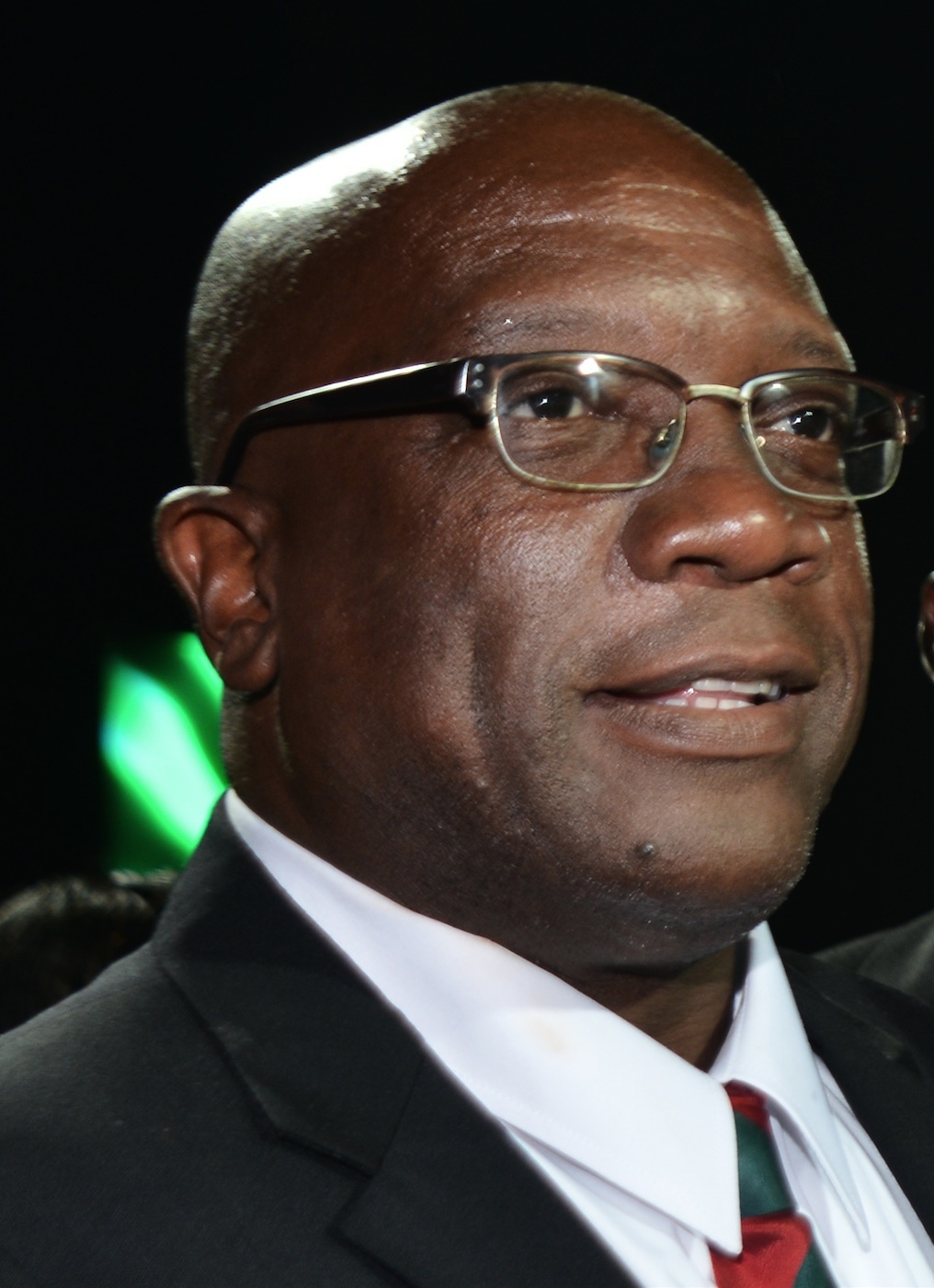
Saint Kitts and Nevis is a federal parliamentary democracy and a Commonwealth realm, and its federal structure is what makes it constitutionally unusual. Nevis has its own island administration, assembly, and premier with substantial devolved powers, and, uniquely among the world's federations, the constitution gives Nevis an explicit right to secede by a two-thirds referendum majority. It has tried: a secession vote in 1998 was carried by about 62 per cent, short of the threshold, and the question has never entirely gone away.
Terrance Drew of the Saint Kitts and Nevis Labour Party has been prime minister since August 2022, when his party ended a decade of government under Timothy Harris and the Team Unity coalition. The federal parliament seats members from both islands, and the balance between them is the permanent structuring fact of national politics.
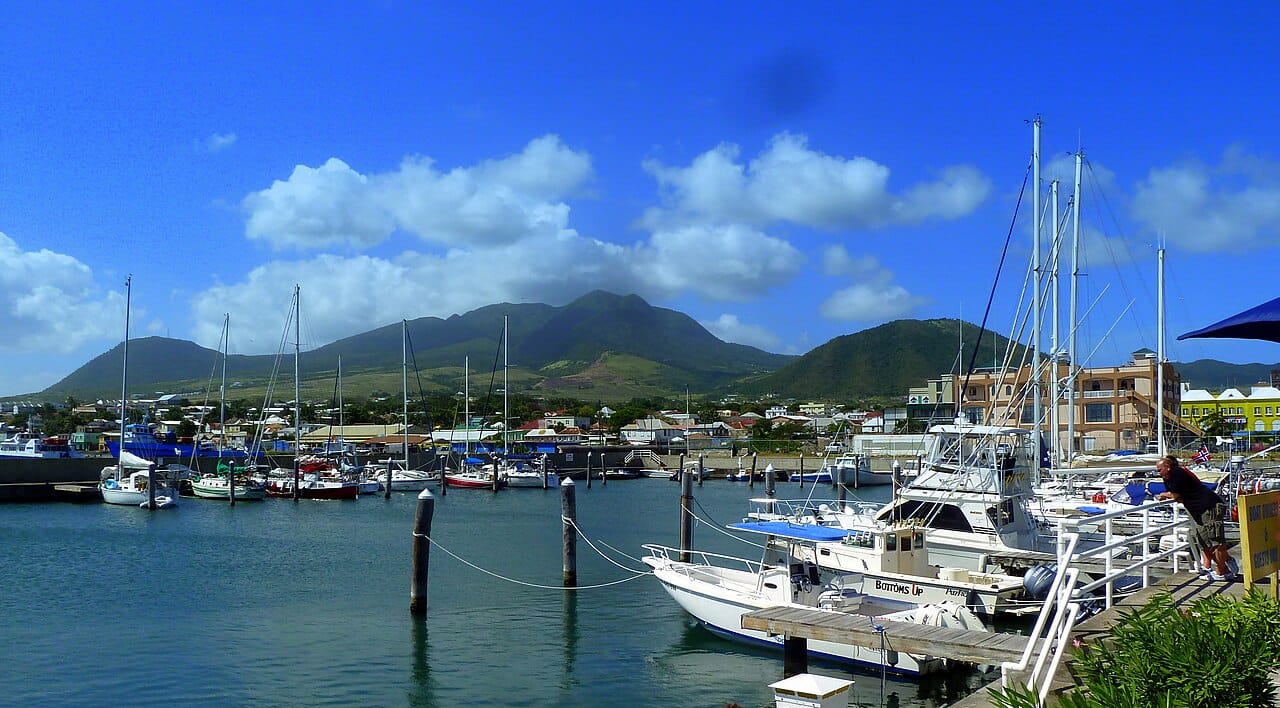
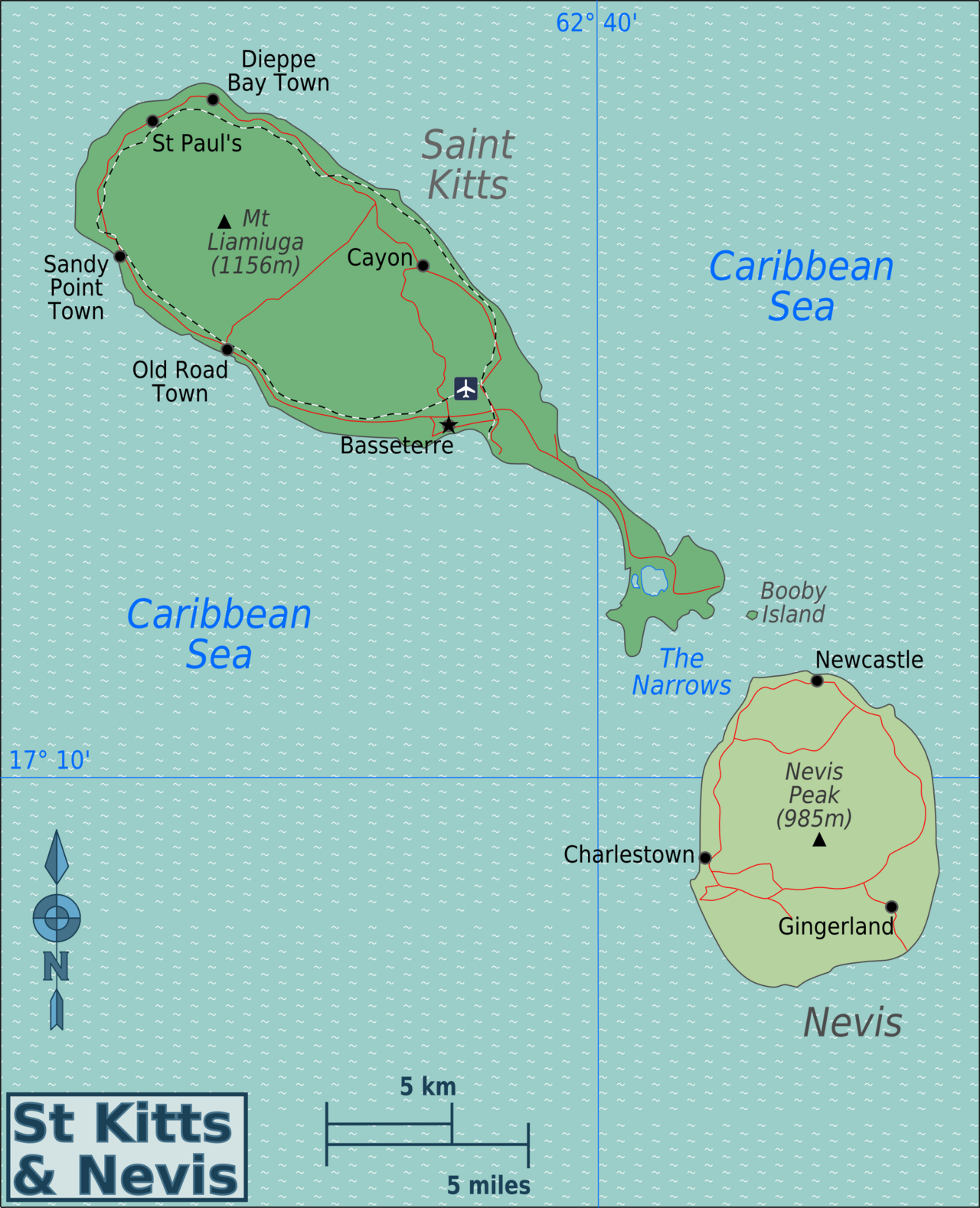
The federation consists of two volcanic islands separated by a two-mile channel called The Narrows, and together they cover only about 261 square kilometres, making this the smallest sovereign state in the Americas by both area and population. Saint Kitts is shaped like a paddle: a central range of forested peaks rising to Mount Liamuiga at 1,156 metres, a dormant volcano with a crater lake, sloping to lower ground that was once entirely under cane, with a long narrow peninsula trailing southeast toward Nevis and holding the best beaches. A railway built to carry the cane still circles the island and now carries tourists.
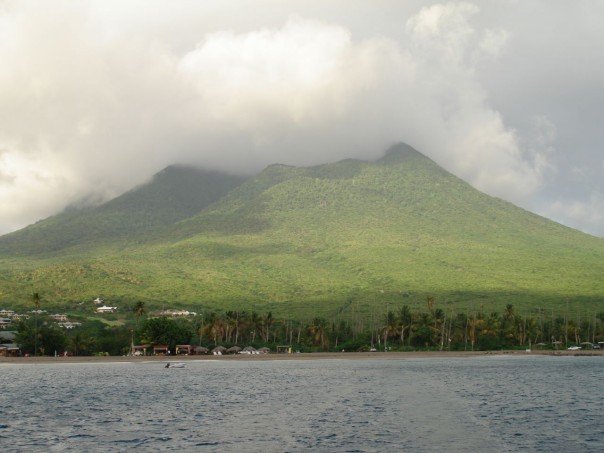
Nevis is almost circular and is essentially one mountain: Nevis Peak, 985 metres, usually wearing a cap of cloud, which is what Columbus is said to have taken for snow when he named it nieves. Both islands are ringed by beaches, dark volcanic sand on the windward side and pale on the leeward, with reefs offshore and vervet monkeys, introduced in the colonial period, now outnumbering people on Saint Kitts. The islands are in the hurricane belt, and Hurricanes Georges in 1998 and Irma and Maria in 2017 all did serious damage.

The flag of Saint Kitts and Nevis has a green lower triangle and a red upper triangle separated by a broad black diagonal band edged with yellow and bearing two white stars. The green represents the fertile land, the red the struggle against slavery and colonialism, the black the African heritage of the people, and the yellow the year-round sunshine. The two white stars stand for the two islands and for hope and liberty. The bold diagonal design has been the emblem of the twin-island federation since independence in 1983.
Saint Kitts and Nevis is a strongly Christian country, reflecting its long British colonial heritage. The Anglican Church was historically prominent, and a range of other Protestant denominations, including Methodist, Moravian, Pentecostal, and others, are widely followed, alongside a Roman Catholic minority. Churches are a familiar part of the landscape and of community life on both islands, and the faith is woven into the culture and its festivals. As across the Caribbean, the religion of the majority reflects the African heritage of the people interwoven with European Christianity.
The cuisine of Saint Kitts and Nevis is Caribbean, blending African, British, and regional influences and making good use of fresh seafood and local produce. The national dish is stewed saltfish served with spicy plantains, coconut dumplings, and seasoned breadfruit, a hearty and flavourful plate. Goat water, a rich stew of goat meat and vegetables, is a beloved speciality, especially on Nevis, and rice, pigeon peas, ground provisions, and tropical fruit feature throughout. Fresh fish and lobster from the surrounding waters round out a satisfying island food culture.
Agriculture in Saint Kitts and Nevis was for centuries dominated by sugarcane, the crop that built the islands' colonial economy on the labour of the enslaved and that covered much of Saint Kitts until the state-run sugar industry was finally closed in the early twenty-first century. Since then the islands have sought to diversify into other crops, including vegetables, fruit, and root provisions, along with some livestock and fishing. Agriculture now plays a small role in an economy that depends chiefly on tourism, offshore financial services, and the sale of citizenship to foreign investors, a programme Saint Kitts and Nevis pioneered.
The closure of the sugar industry in 2005 forced a complete reinvention, and the country managed it. Tourism is now the largest sector, built on cruise calls at Basseterre, the beaches of the southeast peninsula, and a quieter, more upmarket trade on Nevis. Financial services and light manufacturing, particularly electronics assembly, contribute, and Nevis has developed geothermal potential.
The distinctive earner is citizenship by investment. Saint Kitts and Nevis founded the world's first such programme in 1984, a year after independence, and it has been the model every other country has copied; at times it has provided a very large share of government revenue and it funded much of the adjustment after sugar. It has also attracted sustained scrutiny, including a 2014 United States advisory over passports issued to Iranian nationals, after which the country tightened its due diligence, and continuing pressure from the European Union over visa-free access. High public debt following the sugar closure and the 2008 crisis was brought down through a restructuring that included an unusual debt-for-land swap.
Culture in the federation is Afro-Caribbean with a strong British institutional overlay, and its calendar is organised around two carnivals. Saint Kitts holds its National Carnival, called Sugar Mas, from Boxing Day into the new year, with calypso, soca, steel pan, and the masquerade troupes whose costumes and dance carry West African and European elements together; Nevis holds Culturama at the end of July, marking emancipation. Both feature the mocko jumbie stilt dancers and the string bands that are a particular local tradition.
Cricket is the national sport, and Warner Park in Basseterre has hosted World Cup matches; the federation has produced West Indies internationals, and Kim Collins, born on Saint Kitts, won the 100 metres world title in 2003, a remarkable result for a country of this size. Nevis maintains a distinct identity and a certain gentle rivalry with the larger island, which is inseparable from the constitutional question.
Saint Kitts and Nevis has a population of around 50,000, the smallest of any sovereign state in the Americas, of whom roughly four fifths live on Saint Kitts and the rest on Nevis. The great majority are of African descent, with minorities of mixed, British, Portuguese, and Lebanese origin, and a growing number of residents from elsewhere in the Caribbean and from the citizenship programme. English is the official and universal language, spoken alongside a local creole.
Basseterre, on Saint Kitts, is the capital and much the largest town; Charlestown on Nevis is the second. Emigration to Britain, the United States, and the United States Virgin Islands has been heavy for generations, and the diaspora is comparable in size to the resident population. The islands' small scale is visible in everything from a parliament of a few dozen members to a public service where most people know one another, which is both the country's charm and, in the view of local commentators, a persistent challenge for accountability.