The mathematical study of waiting lines, developed to size telephone exchanges and now used wherever demand arrives at random and must be served by limited capacity. Its central results are counterintuitive and explain a great deal of everyday experience.
Agner Krarup Erlang, working for the Copenhagen telephone company, faced a practical question in 1909: how many circuits does an exchange need so that callers are rarely blocked?
Providing a circuit for every subscriber is absurdly expensive, and providing too few produces failed calls. The answer depends on the random pattern of arrivals, which is a probability problem, and Erlang solved it. The unit of offered traffic load is named after him.
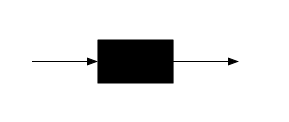
A queueing system is specified by the pattern of arrivals, the distribution of service times, and the number of servers, using a shorthand introduced by David Kendall.
The simplest useful case is written M/M/1: arrivals occurring at random and independently at a constant average rate, service times exponentially distributed, and a single server.
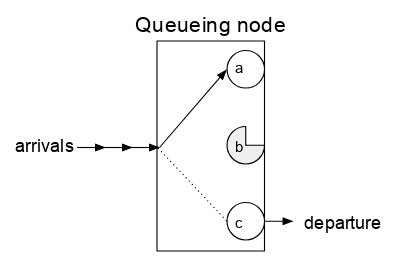
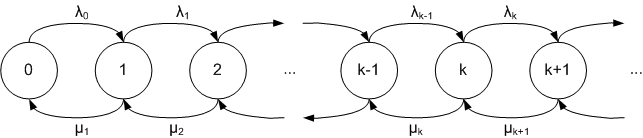
Utilisation is the ratio of the arrival rate to the service rate, and it must be less than one for the queue to be stable. If work arrives faster than it can be served, the queue grows without limit and no amount of patience helps.
The nonlinearity of waiting is the most important. In the simplest model, the average number in the system is the utilisation divided by one minus the utilisation. At fifty per cent utilisation the average queue is one. At ninety per cent it is nine. At ninety nine per cent it is ninety nine.
Waiting time does not rise gently as a system fills; it rises slowly and then explodes near capacity. This is why a hospital emergency department running at ninety five per cent occupancy behaves completely differently from one at eighty, and why running expensive assets at full utilisation is often a false economy.
Little's Law is the most general. The average number of items in any stable system equals the arrival rate multiplied by the average time each spends there. It requires no assumption about arrival patterns, service distributions, queue discipline or number of servers, which is remarkable for a result of such generality, and it was not proved until 1961 by John Little. It is the workhorse of practical analysis, because two of the three quantities are usually easy to measure.
Variability costs capacity. For a given average load, more variable arrivals or more variable service times produce longer queues. Reducing variability improves waiting times without adding any capacity at all, which is a large part of what operations improvement consists of.
A single queue feeding several servers outperforms separate queues for each. With separate lines one server can be idle while another has people waiting, which cannot happen with a shared line. This result is why banks, airports and post offices reorganised their lines, and it is one of the clearest cases of a mathematical result changing everyday physical arrangements.
Telephone and data networks, where it originated and where router buffer sizing and packet delay are queueing problems.
Health services, for emergency department flow, operating theatre scheduling and intensive care bed planning, where the utilisation result has direct consequences for policy.
Manufacturing and logistics, through the field sometimes called factory physics, where the relationship between work in progress, throughput and lead time is Little's Law applied to a factory.
Computing, in processor scheduling, disk access, load balancing and the design of web services.
Traffic engineering, for signal timing and the behaviour of roads near capacity.
The classical assumptions are convenient rather than accurate, and knowing where they break matters.
Real arrivals are often not independent and random. They cluster, they follow daily and weekly cycles, and they respond to the queue itself.
Service times are frequently heavy-tailed rather than exponential, particularly in computing, where a small number of very long jobs dominate the average. Heavy tails break several classical results, and require different scheduling policies.
People are not passive items. They balk at long lines, abandon queues after waiting, choose between lines, and switch, all of which change the dynamics.
Networks of queues are much harder than single queues, and exact results exist only for restricted classes, which is why simulation is standard practice for realistic systems.
Queueing theory explains a class of everyday frustration in a way that is precise and actionable, and its central lesson runs against intuition: a system that is busy almost all the time is not efficient, it is fragile, because the waiting time it produces is governed by how close it runs to the edge rather than by its average load.