A method for making billions of copies of a chosen stretch of DNA from a starting sample too small to work with. It made genetic testing, forensic identification and most of modern molecular biology practical, and it depends on an enzyme from a bacterium living in a hot spring.
Before it, working with a specific piece of DNA meant obtaining enough of it, which generally meant cloning it into bacteria and growing them, taking days and requiring a substantial starting sample.
A great many questions were therefore unanswerable. A trace of blood, a single hair, a few cells from an embryo, a fragment of ancient bone: all contained DNA and none contained enough to analyse.
The cycle has three steps and is repeated.
Denaturation: heat the sample to about 95 degrees, which separates the double helix into single strands.
Annealing: cool to around 55 degrees. Short synthetic primers, designed to match the sequences flanking the region of interest, bind to their complementary sites. The primers are what select the target: only the region between them is copied, so the method amplifies one chosen sequence out of an entire genome.
Extension: warm to around 72 degrees, at which DNA polymerase extends from each primer, copying the strand.
Each cycle doubles the number of copies of the target region. Thirty cycles gives roughly a billionfold amplification, and the whole run takes a few hours in a machine that does nothing but change temperature on a schedule.
The exponential growth is the point, and it is also the method's main vulnerability: a single contaminating molecule is amplified as faithfully as the sample.
The original version had a fatal inconvenience. Ordinary DNA polymerase is destroyed by the heat needed for denaturation, so fresh enzyme had to be added by hand at every cycle.
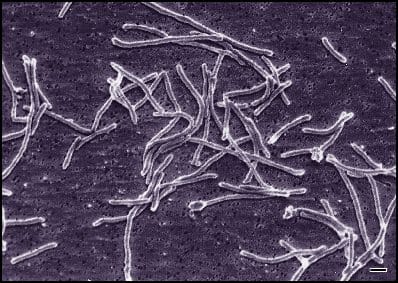
The solution came from Thermus aquaticus, a bacterium isolated from a Yellowstone hot spring by Thomas Brock in 1969, described purely as a curiosity about life at high temperature. Its polymerase functions at 72 degrees and survives 95.
Substituting that enzyme allowed the whole reaction to be sealed in a tube and cycled automatically. The method went from laborious to routine.
This is the standard example in arguments for undirected basic research. Brock was not looking for an enzyme, nobody had proposed amplifying DNA, and the organism was collected because a hot spring was interesting.

Kary Mullis conceived it in 1983, by his own frequently retold account while driving in California. He shared the 1993 Nobel Prize in Chemistry.
The attribution has been argued about. Colleagues at Cetus Corporation did substantial work turning the idea into a working method, and Mullis received a bonus of ten thousand dollars while the company later sold the patent for three hundred million.
Mullis subsequently became known for positions well outside the scientific mainstream, including denying that HIV causes AIDS and rejecting the evidence for human-caused climate change. This is worth recording alongside the achievement rather than instead of it: expertise in one area confers nothing in another, and the invention stands regardless of what its inventor later said.
Diagnostics. Detecting a pathogen's genetic material directly, rather than waiting to culture it or looking for an antibody response. This is how most COVID-19 testing worked, and the reason such tests could be designed within weeks of the virus being sequenced.
Forensics. DNA profiling amplifies specific repetitive regions that vary between individuals, which is what allows identification from trace material. It has secured convictions and, through the Innocence Project and similar work, overturned a substantial number of them.
Genetic testing. Diagnosis of inherited conditions, carrier screening, prenatal testing and tissue typing all depend on amplifying particular sequences.
Ancient DNA. Sequences recovered from Neanderthal bones, from mammoth remains and from archaeological material are amplified before analysis. This is also where contamination is most dangerous, since a researcher's own DNA amplifies far better than degraded ancient material.
Research. Cloning, sequencing, gene expression measurement by quantitative PCR, and site-directed mutagenesis all begin with amplification.
The method requires knowing the flanking sequences in advance, in order to design primers. It cannot find what has not been anticipated, which is why sequencing rather than amplification is used for discovery.
It amplifies short fragments well and long ones poorly. It is exquisitely sensitive to contamination, which is why laboratories separate pre-amplification and post-amplification work physically. And a positive result indicates the presence of a sequence, not of a viable organism, which is a distinction that caused real confusion during the pandemic when people continued to test positive well after ceasing to be infectious.