Identical antibodies produced by a single clone of cells, all binding the same target at the same site. They turned the immune system's specificity into a manufacturing technology, and they are now among the best selling drugs in the world.
An immune response is polyclonal. Many B cell lineages respond to the same target, each producing an antibody binding a different part of it with different strength.
That variety is useful in an infection and a serious obstacle for research or medicine. Serum from an immunised animal contains an uncontrolled mixture, differs between animals and between bleeds, and cannot be reproduced exactly.
What was wanted was a single antibody, defined, unchanging and available in unlimited quantity.
The obstacle was that the B cells producing a given antibody cannot be grown indefinitely in culture, since normal cells divide a limited number of times and then stop.
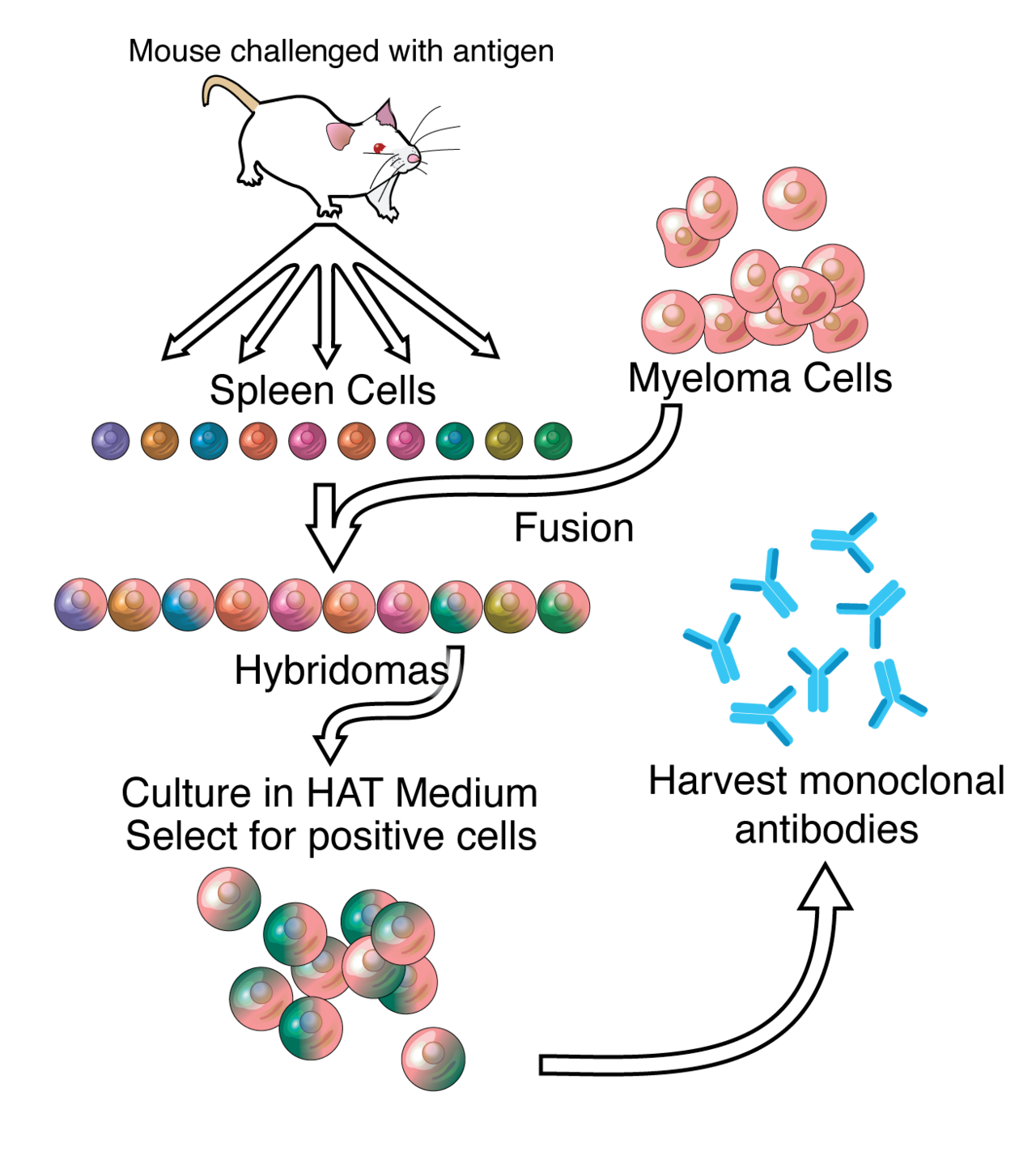
Georges Köhler and César Milstein solved it in 1975 by fusing two cell types.
A B cell from an immunised animal produces the desired antibody and cannot be cultured indefinitely. A myeloma cell, a cancerous plasma cell, divides indefinitely and produces nothing useful.
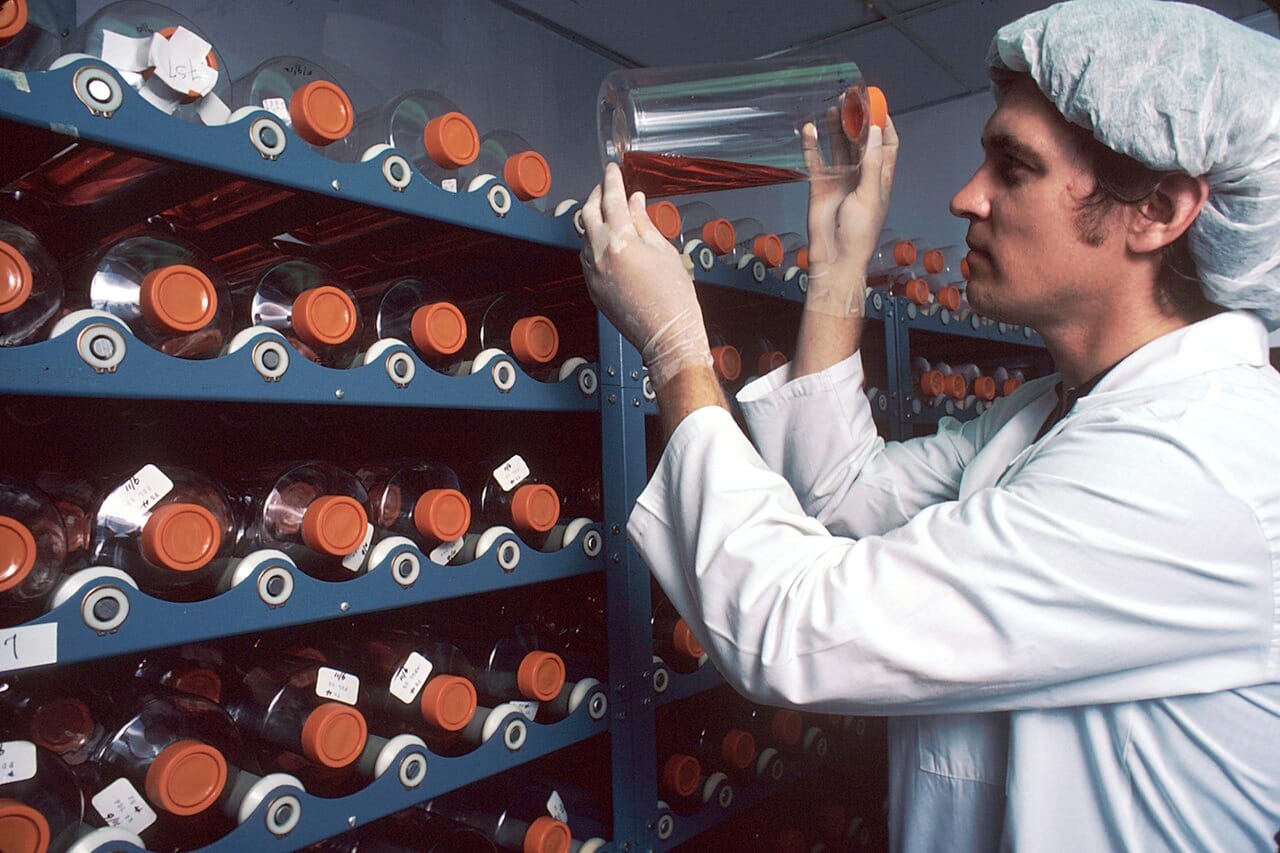
Fusing them produces a hybridoma, which inherits both properties: it produces the antibody and it divides without limit. Individual hybridomas are then separated and grown as clones, and the one making the wanted antibody is selected and kept.
Köhler and Milstein shared the Nobel Prize in 1984. They did not patent the technique, a decision that has been much discussed since given its commercial value.
Early monoclonals were made in mice, which caused a problem in patients: the human immune system recognises mouse protein as foreign, attacks it, and clears the drug, sometimes with severe reactions.
The solution was progressive humanisation, replacing mouse sequence with human sequence while preserving the part that binds the target.
Chimeric antibodies are part mouse and part human. Humanised antibodies retain only the small binding loops from the mouse. Fully human antibodies are produced from transgenic mice carrying human antibody genes, or by display technologies that select binders from very large libraries.
The naming convention records this. Drug names ending in ximab are chimeric, zumab humanised and umab fully human, so the name itself states how the antibody was made.
Cancer. Some monoclonals mark tumour cells for immune destruction, some block growth signals, and some carry a toxin or radioactive isotope directly to the target. Checkpoint inhibitors are antibodies that release the brakes tumours use to suppress immune attack, and they have produced durable responses in cancers that were previously untreatable.
Autoimmune and inflammatory disease. Antibodies that neutralise specific inflammatory signals transformed treatment of rheumatoid arthritis, inflammatory bowel disease and psoriasis, and drugs of this class have been among the highest-revenue pharmaceuticals in the world.
Infectious disease. Monoclonals against specific pathogens have been used for respiratory syncytial virus, Ebola and COVID-19, with the significant limitation that a virus which mutates in the target region escapes them, which occurred repeatedly during the COVID-19 pandemic.
Diagnostics. Most rapid tests, including pregnancy tests and lateral flow tests, use monoclonal antibodies to detect a specific molecule, and they are the standard reagent in laboratory identification of cell types.
They are proteins, so they are digested if swallowed and must be injected or infused.
They are large and do not cross the blood brain barrier efficiently, which limits their use in neurological disease.
They are expensive. Production requires mammalian cell culture under stringent conditions, and courses of treatment commonly cost tens of thousands per year. Biosimilars, which are comparable versions produced after patents expire, reduce this and cannot be identical in the way a small-molecule generic can, because a protein made in living cells varies slightly.
They act outside cells or at cell surfaces, so intracellular targets are largely inaccessible.
Monoclonal antibodies converted a biological phenomenon into a general-purpose targeting technology: given a molecule worth binding, an antibody can usually be raised against it and manufactured indefinitely.
That generality is why they now span cancer, autoimmunity, infection and diagnosis, and why a technique developed to solve a laboratory reagent problem became one of the largest categories in modern medicine.