The framework, introduced by Harry Markowitz in 1952, that treats investment as a trade-off between expected return and risk measured as variance, and shows that combining assets which do not move together reduces risk without a proportional reduction in return. It made diversification a quantitative result rather than a proverb.
Before 1952, investment analysis concentrated on selecting good individual securities. Markowitz's contribution was to show that the risk of a portfolio is not the average of the risks of its holdings.
Because assets do not move perfectly together, the variance of a portfolio depends on the covariances between its holdings as well as on their individual variances. Combining assets whose returns are imperfectly correlated produces a portfolio less variable than the weighted average of its parts, and if correlations are low enough, less variable than any single holding.
The consequence for valuing an individual asset is the part that reoriented the field. What matters about a security is not how risky it is on its own, but how it moves with everything else already held. A volatile asset that moves against the rest of a portfolio reduces total risk, and adding it can be prudent precisely because it is volatile.
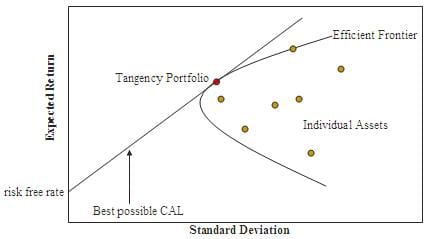
For any set of assets and any target return, there is a combination with the lowest achievable variance. The set of such portfolios forms the efficient frontier, and every portfolio below it is dominated, offering less return for the same risk.
Which point on the frontier to choose is a matter of the investor's tolerance for risk, and the theory declines to answer it. This separation of the objective problem from the preference is deliberate.
James Tobin added that if a risk-free asset exists, every investor should hold some combination of it and one particular portfolio of risky assets, the tangency portfolio, varying only the proportions. Risk preference then determines how much to borrow or lend, not which risky assets to hold.
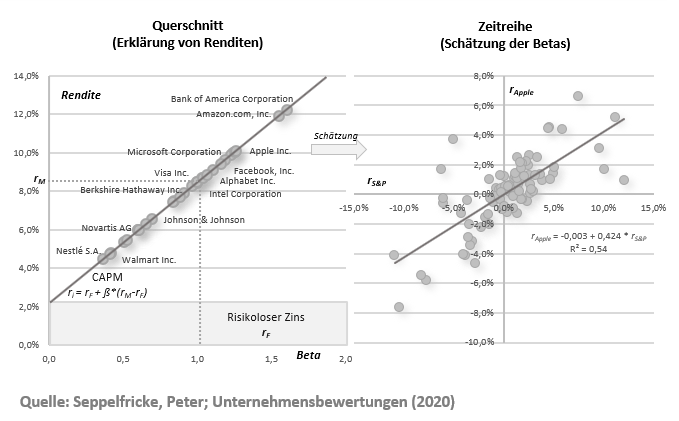
William Sharpe, John Lintner and Jan Mossin took the further step of asking what prices would prevail if everyone did this, giving the capital asset pricing model. In equilibrium the tangency portfolio is the market portfolio, and an asset's expected return depends only on its sensitivity to market movements, called beta. Risk that can be diversified away earns no return, because no one needs to bear it.
Markowitz shared the 1990 Nobel Memorial Prize in Economics with Sharpe and Merton Miller.
The framework's problems are well documented and are mostly problems of inputs and of assumptions about the shape of returns.
Estimation error is the most damaging in practice. The optimiser requires expected returns, variances and every pairwise covariance, all estimated from historical data, and it responds to those estimates aggressively. Small errors in expected returns produce large, concentrated and unstable allocations, which is why the procedure has been described as an error maximiser. Naive equal weighting frequently outperforms optimised portfolios out of sample, a result that has held up across many datasets.
Variance is a questionable measure of risk. It treats upside and downside deviation identically, whereas investors do not, and it is the right summary only if returns are normally distributed or preferences are quadratic. Asset returns have fatter tails than the normal distribution, so extreme events are far more frequent than the model implies, and risk measures based on downside or on tail loss were developed in response.
Correlations are not stable and they move in the least helpful direction. Diversification depends on assets not falling together, and in severe market declines correlations across risky assets tend to rise toward one, so the benefit shrinks exactly when it is needed. This is a structural criticism rather than an estimation problem.
The capital asset pricing model performs poorly empirically. Beta explains much less of the cross-section of returns than it should, and characteristics it says should not matter, notably company size, the ratio of book value to price, momentum and profitability, do. The Fama and French factor models were a response, and they improve the description while abandoning the claim that a single market factor suffices.
The behavioural critique is that investors do not evaluate outcomes as variance around an expected return but relative to reference points and asymmetrically, which is treated in the prospect theory capsule, and that the efficient markets assumption underlying the equilibrium extension is itself contested in its own capsule.
The specific machinery is used with heavy modification, and the core claims have held.

Risk and return are related and cannot be separated. Diversification reduces risk and is the closest thing to a free improvement available. An asset's contribution to portfolio risk matters more than its standalone volatility. And the difficulty of beating a diversified portfolio after costs is the practical argument for index investing, which is the largest change in investor behaviour of the past fifty years and follows directly from this line of reasoning.
Practitioners generally use the framework with constraints on position sizes, with shrinkage applied to the estimated inputs, or in variants such as the Black Litterman model that combine market-implied returns with explicit views, precisely because the unconstrained optimiser is unusable on raw historical estimates.
Modern portfolio theory turned investing into a subject with formal structure and made risk something to be measured and allocated rather than avoided. Its vocabulary, of diversification, correlation, systematic risk and risk-adjusted return, is now the ordinary language of finance, and its practical descendant, the low-cost diversified index fund, holds a large share of the world's invested savings.