Whether a legally mandated wage floor reduces employment. Introductory economics gives a clear prediction, three decades of careful empirical work has not confirmed it at the levels studied, and the disagreement is now about magnitude, method and how far the results extend.
In a competitive labour market with many employers competing for workers, the wage equals the value of what the last worker produces. Set a floor above that and employers will hire fewer workers, because some workers now cost more than they produce.
The prediction is unambiguous and follows directly from the model. For most of the twentieth century it was treated as settled, and surveys of economists showed large majorities agreeing that a minimum wage increases unemployment among the low-skilled.
The turning point was a 1994 study by David Card and Alan Krueger. New Jersey raised its minimum wage and neighbouring Pennsylvania did not, so they surveyed fast food restaurants on both sides of the border before and after.
Employment in New Jersey did not fall relative to Pennsylvania. If anything it rose slightly.
The result was contested immediately. David Neumark and William Wascher reanalysed the question using payroll records rather than telephone surveys and found employment losses, and the dispute over which data source was more reliable ran for years without resolution.
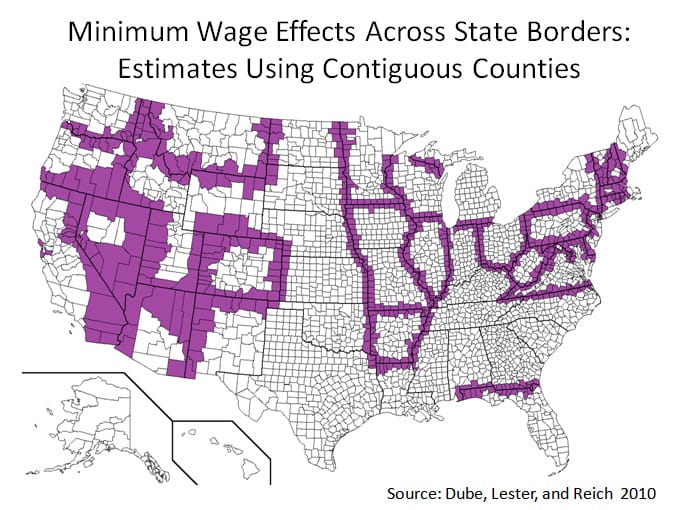
The method generalised. A 2010 study by Arindrajit Dube, William Lester and Michael Reich compared all pairs of contiguous United States counties separated by a state border with different minimum wages, on the reasoning that neighbouring counties share local economic conditions. Earnings rose and employment did not fall.
A 2019 study by Doruk Cengiz and colleagues took a different approach, counting jobs across the whole wage distribution. Jobs paying below the new minimum disappeared and jobs paying at or just above it appeared in nearly equal number, so the number of jobs was roughly unchanged while their pay was higher.
David Card shared the Nobel Memorial Prize in 2021, in part for this work and for the natural-experiment methods it helped establish.
The disagreement is not mainly about ideology, and it is worth setting out what is actually contested.
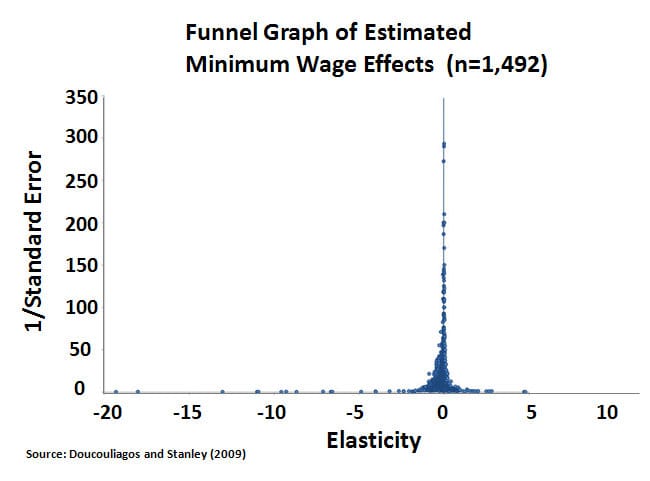
Publication bias is documented. Meta-analyses by Hristos Doucouliagos and Tom Stanley found the distribution of published estimates skewed toward negative employment effects in a pattern indicating selective reporting, with the most precise estimates clustering near zero.
Method drives results. Which comparison group is chosen, how state-specific trends are handled, and which time window is used can move estimates from clearly negative to clearly positive using the same underlying data. The Seattle minimum wage increase is the standard illustration: one research team reported substantial reductions in hours worked and another found no such effect, analysing the same policy.
Margins other than headcount may absorb the change. Employers can reduce hours, cut scheduled shifts, reduce non-wage benefits, raise prices, accept lower profit, or reduce turnover costs. Studies that count jobs may miss adjustments that count for workers.
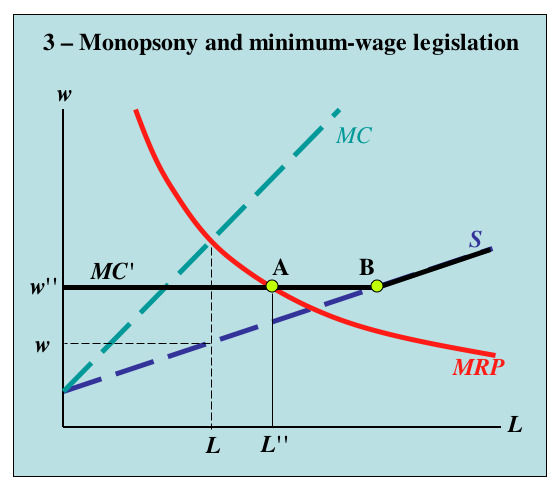
The most important theoretical development is that labour markets may not be competitive in the way the standard model assumes.
If employers have wage-setting power, whether because workers face search costs, geographic constraints, imperfect information or few local employers, then an employer restricts hiring to keep wages down. A minimum wage set within the right range removes that incentive and can raise employment as well as pay.
This is not a special pleading device. It is a standard model with substantial supporting evidence, including findings that firms face upward-sloping labour supply curves and that labour market concentration is associated with lower wages.
Its practical implication is important: the sign of the employment effect depends on where the minimum is set relative to prevailing wages, so there need not be a single answer.
Moderate increases from a low base have small employment effects, and the disagreement concerns whether the effect is slightly negative or approximately zero rather than whether it is large.
Wages of affected workers rise, and there is no serious dispute about that.
The evidence base is drawn overwhelmingly from increases within the range historically observed, mostly in the United States, mostly below about half the local median wage. Very large increases, and increases in low-wage regions where the floor binds much more, are far less studied, and most researchers on both sides accept that results do not automatically extend to them.
This literature changed how economics is done. The natural-experiment approach that Card and Krueger applied here spread through the discipline and is now standard, and the recognition that a clean theoretical prediction can fail empirically made the field more empirical in general.
It is also a live policy question affecting tens of millions of workers, being decided in an evidence environment where the honest summary is that the effect at levels studied is small, that the range studied is narrower than the range being proposed, and that the discipline's confident prior turned out not to survive measurement.