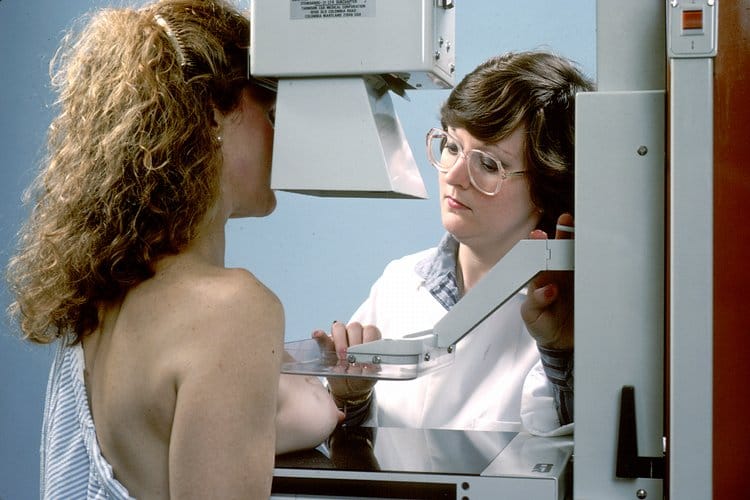
The continuous collection and analysis of health data to detect outbreaks, monitor trends and guide response. It is the information system on which public health acts, and its value lies in being routine rather than reactive.
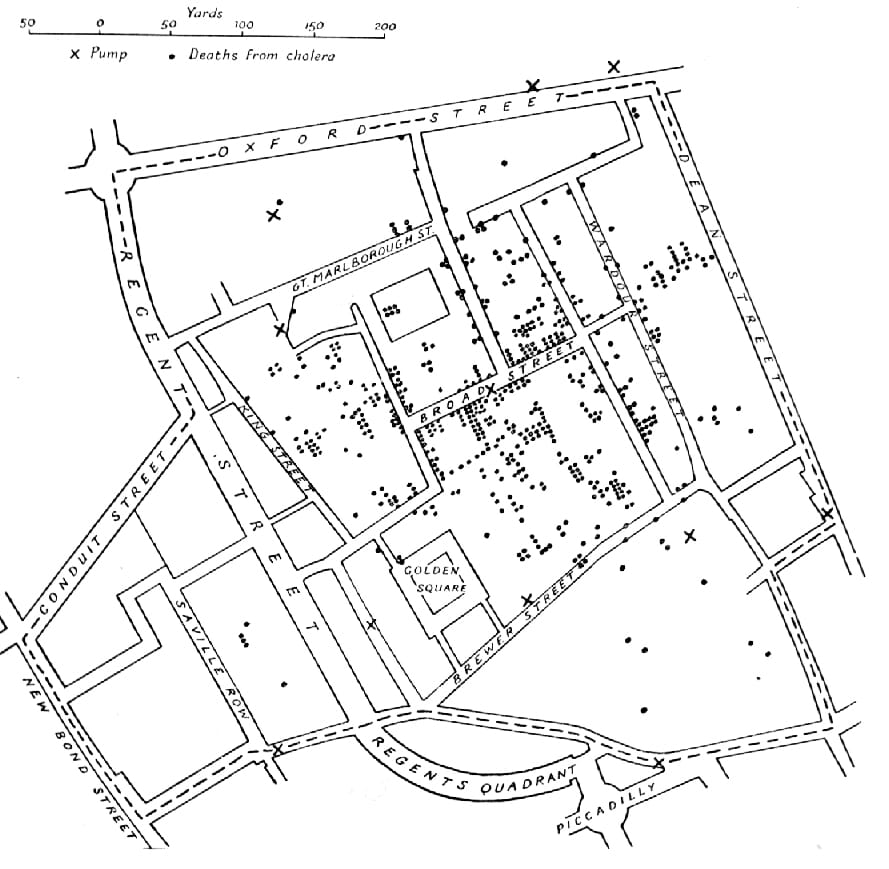
In 1854 a cholera outbreak in Soho, London, killed several hundred people within days.
The prevailing explanation was miasma, treated in its own capsule: disease arising from foul air. John Snow held that cholera was transmitted by contaminated water.
He mapped deaths and found them clustered around a public water pump in Broad Street. The anomalies were as informative as the pattern: a nearby workhouse with its own well had few deaths, and a brewery whose workers drank beer had none, while a woman who had moved away but had water delivered from the pump because she preferred its taste died of the disease.

Snow had the pump handle removed. The outbreak was already declining and the causal argument stood, and the episode established the method rather than resolving that outbreak.
The vibrio causing cholera was not identified for another thirty years, which is the important point: the transmission route was established, and effective action taken, without knowing the agent.
Passive surveillance relies on clinicians and laboratories reporting notifiable conditions to health authorities. It is inexpensive and covers everything, and it under-reports substantially and lags.
Active surveillance involves health authorities contacting providers to seek cases. It is more complete and more expensive, and is used for eradication programmes and during outbreaks.
Sentinel surveillance monitors a selected sample of sites intensively rather than attempting complete coverage, which gives better data quality and timeliness at the cost of completeness. Influenza monitoring commonly works this way.
Syndromic surveillance monitors symptoms rather than diagnoses, using emergency department presentations, prescription sales or absence records, which detects a signal earlier at the cost of specificity.
Laboratory and genomic surveillance sequences pathogens to identify variants and trace transmission chains. This expanded enormously during the COVID-19 pandemic and is now standard for several pathogens.
Wastewater surveillance measures pathogen material in sewage, capturing infections regardless of whether anyone sought care or was tested, and it has been used for polio for decades and much more widely since 2020.
Outbreak detection is the function most associated with it, and it requires a baseline: an unusual number of cases can only be recognised against knowledge of the usual number.
Trend monitoring tracks chronic as well as infectious conditions and informs resource allocation.
Programme evaluation measures whether interventions work, since a vaccination campaign's effect appears in surveillance data.
Elimination verification requires demonstrating absence, which needs a surveillance system sensitive enough that cases would have been found if present. This is why eradication programmes invest heavily in surveillance, as the smallpox effort described in the contact tracing capsule shows.
Early warning at international level operates through the International Health Regulations, which require states to report events that may constitute a public health emergency of international concern.
Reporting incentives work against the system. A state reporting an outbreak may face trade restrictions, travel bans and economic damage, which creates a direct incentive to delay, and delays have occurred in several major outbreaks.
Completeness and timeliness trade against each other. A system fast enough to be actionable is generally less complete, and one complete enough to be definitive is generally too slow to act on.
Sensitivity and specificity trade similarly. Lowering the threshold for an alert catches more real events and generates more false alarms, and repeated false alarms erode response.
Privacy is a genuine tension. Surveillance requires individual health data, and the more granular the data the more useful and the more intrusive it is.
Capacity is unevenly distributed. The places where novel pathogens are most likely to emerge frequently have the least developed surveillance, which is a structural weakness in the global system rather than a local failing.
Surveillance is what converts scattered individual illness into a recognisable event that can be acted on, and every outbreak response begins with it.
Snow's map also demonstrates something durable about the method. He identified the source, argued the case and prompted action without knowing what caused cholera, because systematically comparing who fell ill against who did not was sufficient. That remains the core technique.