The mathematics of making a system behave as intended by measuring what it is doing and acting on the difference from what is wanted. It is the reason machines hold a setting, aircraft that cannot fly themselves can be flown, and a body maintains its temperature.
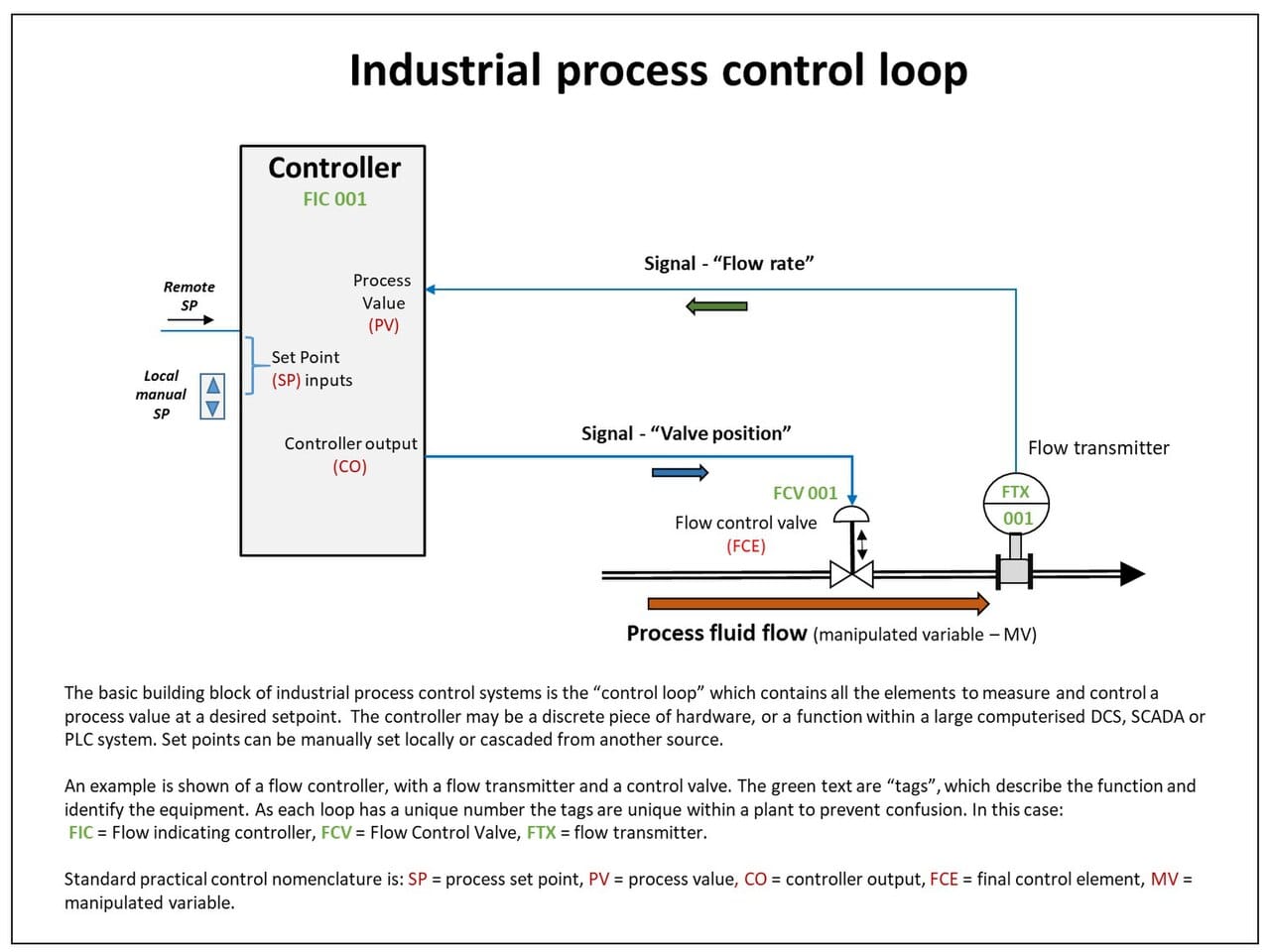
Feedback control measures the output of a system, compares it with a desired value, and uses the difference to decide what to do next. The loop runs continuously, so disturbances are corrected as they occur rather than anticipated.
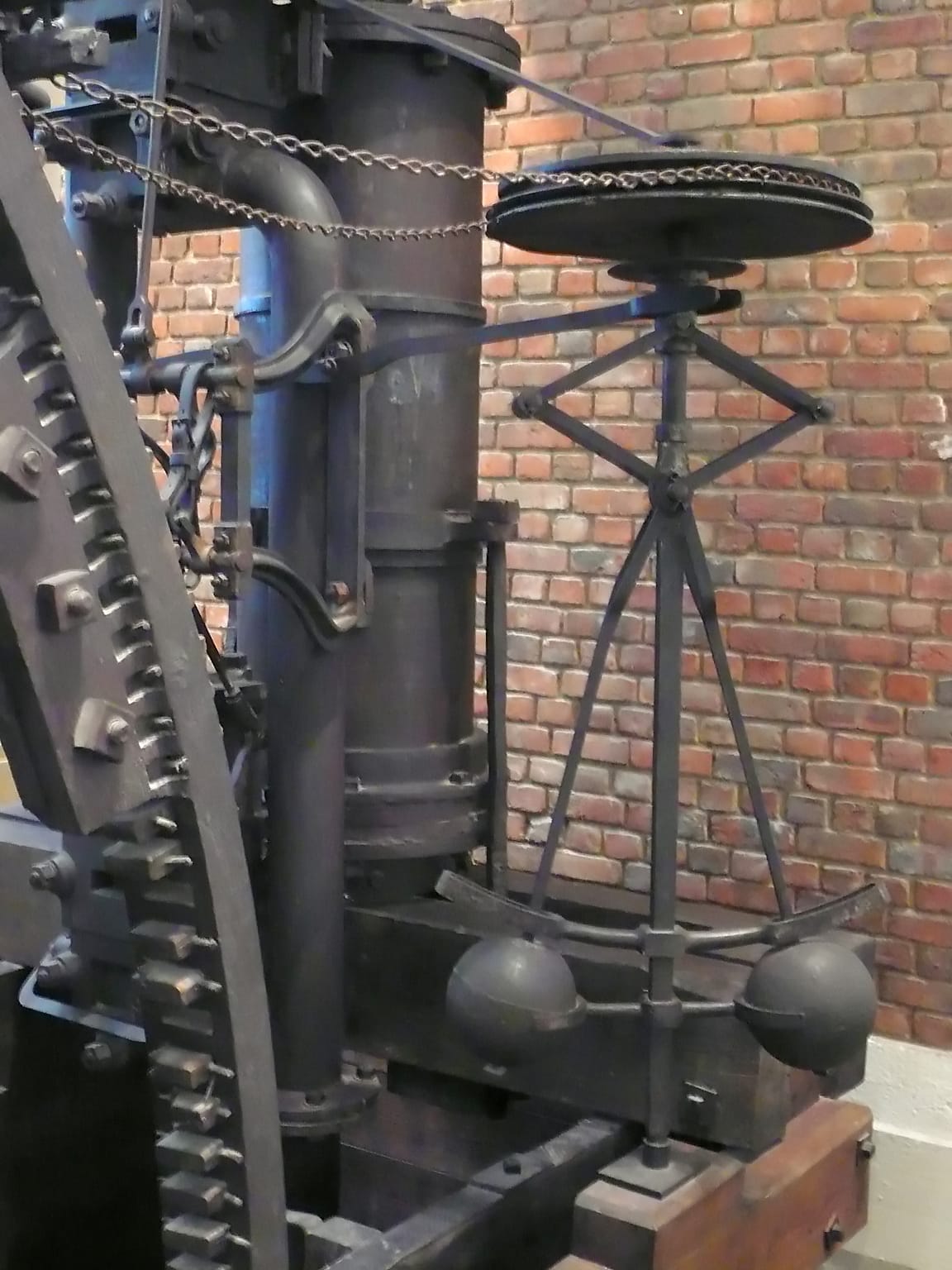
The centrifugal governor is the canonical mechanical example. Rotating weights fly outward as the engine speeds up, and their motion closes the steam valve. Nothing measures anything in the modern sense, and it is nonetheless a complete feedback loop.
The crucial property is that feedback does not require an accurate model of the disturbance, or even of the system. It requires only that the error can be measured and that acting on it moves the output in the right direction.
Governors sometimes oscillated instead of settling, and no one could say why. James Clerk Maxwell analysed the problem in 1868 in a paper titled On Governors, showing that stability depends on the roots of a characteristic equation, and turning a practical nuisance into a mathematical criterion. It is generally taken as the founding paper of the field.
The second major development came from telephony rather than mechanics. Harold Black invented the negative feedback amplifier at Bell Labs in 1927, trading gain for stability and linearity, and the resulting need to predict when such amplifiers would oscillate produced the frequency-domain methods of Harry Nyquist in 1932 and Hendrik Bode. Their stability criteria and plots remain standard.
The proportional, integral and derivative controller, which acts on the present error, its accumulation and its rate of change, emerged in the same period and remains the most widely deployed control algorithm in the world.
A third development came with the space programme. Rudolf Kálmán's state-space formulation around 1960 handled systems with many inputs and outputs, and the Kalman filter, which estimates a system's state from noisy measurements, was implemented in the Apollo guidance computer and is now used in essentially every navigation system.
Stability is the first requirement, and it is not automatic. A loop with too much gain, or with delay between measurement and action, will overshoot, then overcorrect, and oscillate or diverge. Delay is the persistent enemy: it means the controller is acting on information about a situation that has already changed.
Gain and phase margins quantify how much a system can change before a stable loop becomes unstable, which matters because real systems age, wear and vary.
Controllability and observability ask whether the available inputs can drive the system to any desired state, and whether the available measurements are sufficient to determine what the state is. Kálmán's formulation made these precise, and they determine whether a control problem is solvable at all before any controller is designed.
Robustness concerns performance when the model is wrong, which it always is. A controller tuned perfectly to a model and fragile to small deviations is of no practical use.
Feedback is not free, and the constraint is a theorem rather than an engineering shortcoming.
Bode's sensitivity integral states that for a broad class of systems, reducing sensitivity to disturbances at some frequencies necessarily increases it at others. The area under the curve is fixed. Pushing disturbance rejection down in one band pushes it up somewhere else.
This is often called the waterbed effect, and it means that control design is the allocation of an unavoidable quantity of badness rather than its elimination. Knowing where to put it is much of the skill.
Thermostats, cruise control, engine management and industrial process plants are the familiar cases.
Aircraft are the most striking. Modern fighter aircraft are aerodynamically unstable by design, because instability gives manoeuvrability, and they are flyable only because a control system corrects them many times a second. The aircraft cannot be flown without the controller in any meaningful sense.
Power grids hold frequency within a narrow band by continuously matching generation to load, which is a control problem at continental scale.
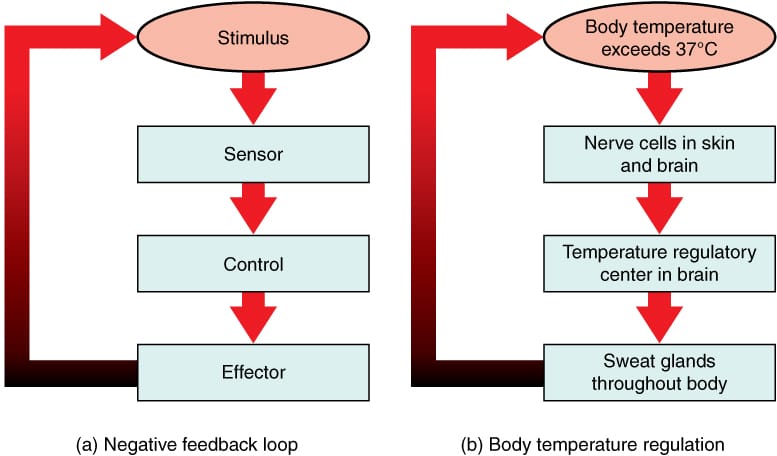
Biology is full of it. Body temperature, blood glucose, blood pressure and gene expression are all regulated by feedback loops, and control theory is used to analyse them.
Economics and ecology borrow the same framework, with the caution that a system which anticipates the controller behaves differently from a steam engine.
Control theory is the reason automation is possible at all, since a machine that cannot correct itself must be either perfect or supervised. It also supplies one of the more useful general ideas available: that a system's behaviour is often determined less by its components than by the loops connecting them.