Legally enforceable agreements. They allow people to bind their future selves, which makes cooperation possible between parties who have no other reason to trust one another, and they are the legal foundation of commerce.

Not every promise is enforceable. Legal systems require several elements, and the common law formulation is representative.
Offer and acceptance, meaning a proposal on definite terms and an unqualified assent to it.
Consideration, meaning that each party gives something of value. A gratuitous promise is generally unenforceable in common law systems unless made in a particular form, which is why a promise to make a gift binds no one.
Intention to create legal relations, which distinguishes commercial agreements from social arrangements.
Capacity, meaning the parties are legally able to contract, which excludes children and, in defined circumstances, those lacking mental capacity.
Legality, since an agreement to do something unlawful is unenforceable.
Civil law systems, deriving from Roman law, generally do not require consideration and treat agreement itself as sufficient, which is one of the clearest structural differences between the two traditions.
Contract is among the oldest legal categories, and written contracts are among the earliest uses of writing, as the writing systems capsule notes.
Roman law developed a detailed classification of agreements and much of the modern civil law of contract descends from it directly.
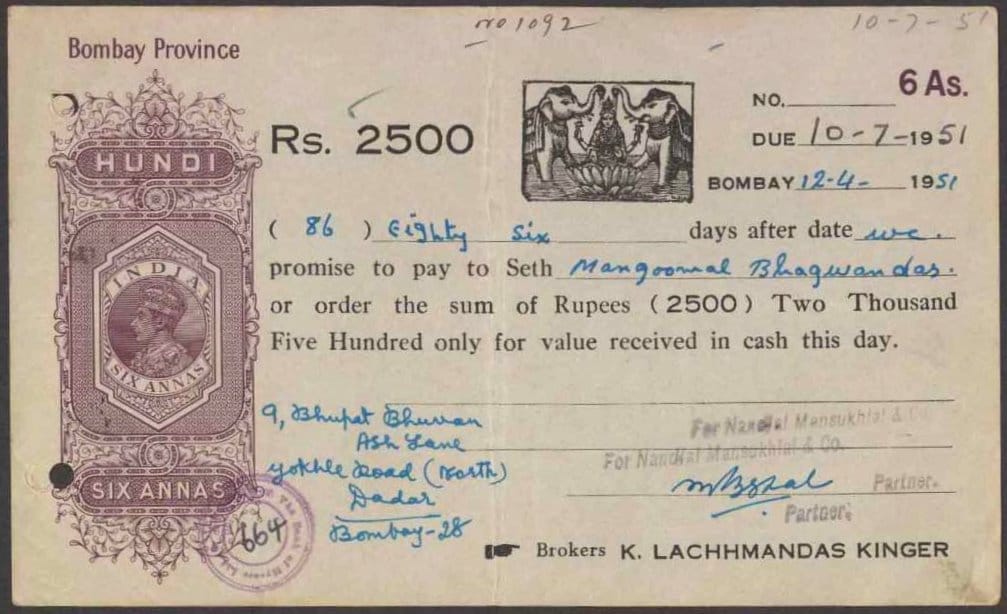
Merchant custom, the lex mercatoria, developed across medieval Europe as traders needed rules that worked across jurisdictions, and much of it was later absorbed into national law.
Comparable instruments developed elsewhere. The hundi in South Asia and the suftaja in the Islamic world allowed credit and payment obligations to be transferred over distance, performing the function of the bill of exchange.
English common law developed contract through decided cases rather than codification, which is why its rules are stated as principles extracted from judgments.
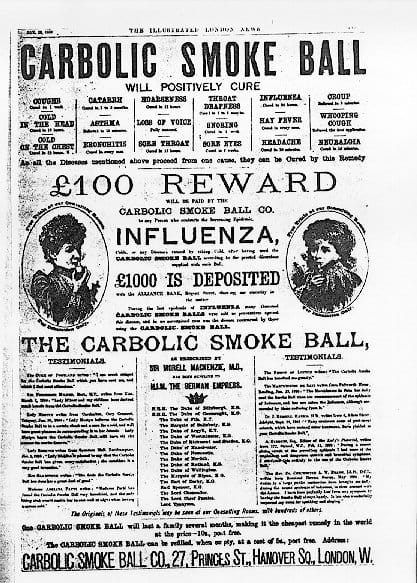
Carlill against Carbolic Smoke Ball Company, decided in England in 1893, is the most taught contract case in the common law world.
The company advertised that it would pay one hundred pounds to anyone who used its smoke ball as directed and still contracted influenza, and stated that it had deposited a thousand pounds with a bank to show its sincerity. Mrs Carlill used it, caught influenza and claimed.
The company argued that an advertisement is not an offer, that there was no agreement with any particular person, and that the promise was mere puff.
The court held otherwise. An advertisement can be an offer to the world at large, accepted by performing the specified conditions, and the deposit demonstrated that the promise was intended seriously.
The case established that unilateral offers are binding, which matters for rewards, competitions and a great deal of modern consumer commerce.
Breach occurs where a party does not perform. The standard remedy in common law is damages intended to put the injured party in the position they would have occupied if the contract had been performed.
Specific performance, an order to actually perform, is exceptional in common law and more readily available in civil law systems.
Contracts can be set aside for misrepresentation, mistake, duress or undue influence, each of which concerns the quality of the agreement rather than its terms.
Frustration and force majeure address events after formation that make performance impossible or radically different, and the COVID-19 pandemic generated substantial litigation on exactly this.
Unfair terms are regulated by statute in most jurisdictions, particularly in consumer contracts, on the reasoning that formal freedom to agree means little where one party sets the terms and the other can only accept or decline.
Standard form contracts, offered without negotiation, are the normal case rather than the exception. Almost every consumer contract is of this kind, and the classical model of two parties bargaining describes very little modern contracting.
Click-wrap and terms of service agreements have been widely enforced despite near-universal evidence that they are not read, which is a recognised tension between the doctrine of agreement and the practice.
Smart contracts, self-executing code on a distributed ledger, automate performance. Whether they are contracts in the legal sense, and what happens when the code does something the parties did not intend, are unsettled questions.
Contract is the mechanism that allows strangers to cooperate on the strength of an enforceable promise rather than on trust or kinship, which is a precondition for commerce beyond a community where reputation suffices.
Its evolution also tracks a broader legal shift. The classical model assumed equal parties freely negotiating, and most of the modern law consists of qualifications introduced because that assumption is usually false.