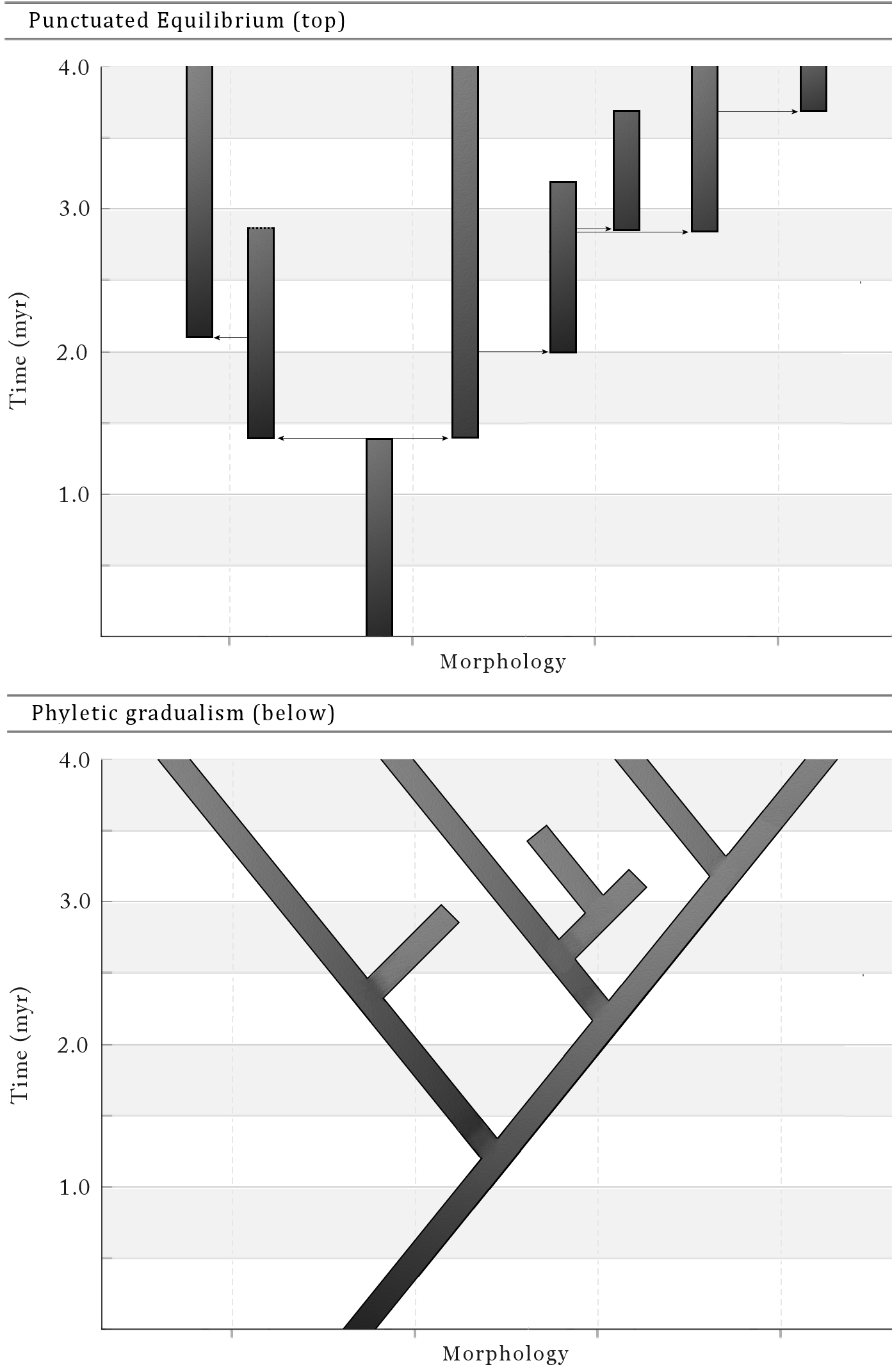
Punctuated equilibrium is a theory about the pace of evolution. It proposes that species tend to remain largely unchanged for long stretches of time, and that most evolutionary change happens in relatively rapid bursts, usually when new species split off, rather than through slow and steady transformation. Put forward in 1972, it reshaped how biologists read the fossil record and sparked one of the liveliest debates in modern evolutionary science.
The theory contrasts with the older picture of evolution as a gradual, continuous process in which species slowly change generation by generation. Punctuated equilibrium suggests instead that long periods of stability, called stasis, are the norm, interrupted by comparatively brief episodes of rapid change concentrated around the moment when a population splits into a new species. On the vast timescale of the fossil record, those bursts can look almost instantaneous.
The theory was proposed by the palaeontologists Niles Eldredge and Stephen Jay Gould, who argued that the fossil record should be taken at face value. For many species, that record shows long stretches with little change, then the relatively sudden appearance of a distinct new form, rather than a smooth series of intermediates. They argued this pattern was not merely a gap in the fossils but a genuine feature of how evolution often works.
Punctuated equilibrium provoked vigorous and sometimes heated debate. Some biologists felt it was overstated, arguing that gradual change is still common and that the rapid bursts are not as different from ordinary evolution as claimed. Others embraced it as an important correction. The disagreement, though sometimes fierce, was a debate over the rhythm and tempo of evolution, not over whether evolution occurs, which is not in doubt.
Today most biologists see punctuated equilibrium and gradual change as two ends of a spectrum, with the real pace of evolution varying from case to case. Far from challenging Darwin, the theory enriched the understanding of how natural selection plays out over deep time, and it remains an influential framework for interpreting the long history of life recorded in the rocks.
