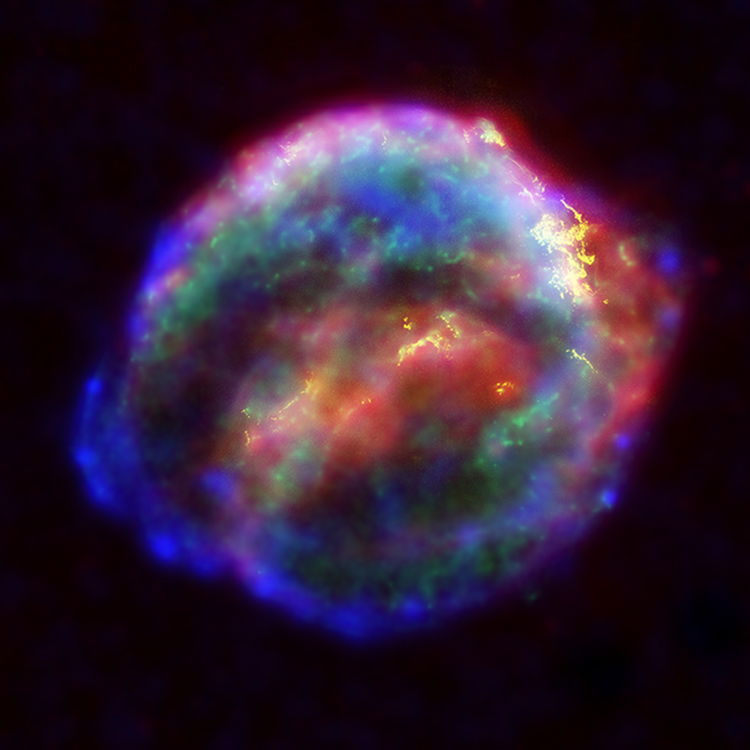
Stellar nucleosynthesis is the theory explaining where the chemical elements come from. It holds that the stars are the furnaces in which almost all the elements heavier than hydrogen and helium are forged, built up from lighter ones by nuclear reactions in stellar cores and in the violent deaths of stars. The carbon in our bodies, the oxygen we breathe, and the iron in our blood were all made inside stars long ago, a conclusion captured in the famous saying that we are made of stardust.
The theory describes a series of stages. The Big Bang produced only the lightest elements, hydrogen and helium with a trace of lithium. Inside stars, the crushing heat and pressure fuse hydrogen into helium, and in more massive stars helium fuses into carbon, oxygen, and on up the ladder to iron. The very heaviest elements, such as gold and uranium, require even more extreme conditions, forged in the explosions of dying stars and in the collisions of their dense remnants.
This is not a poetic flourish but a literal account of our origins. Every atom in the human body heavier than hydrogen was manufactured inside a star and scattered into space when that star died, later to be gathered into new stars, planets, and eventually living things. The same handful of elements that make up people, oceans, and rocks are found throughout the cosmos, all traceable to stellar furnaces.
The theory is strongly supported by several lines of evidence. The light from stars, split into its colours, reveals the exact elements present and shows them being made. The predicted amounts of each element match what astronomers actually measure across the universe with impressive accuracy. And in 2017 astronomers directly observed two collapsed stars colliding and watched heavy elements being created in the aftermath, confirming a long predicted source of the heaviest atoms.
Stellar nucleosynthesis unites the very large and the very small, explaining the chemistry of all matter through the life and death of stars. It is one of the great achievements of twentieth century science, and the reason astronomers can say, with evidence rather than metaphor, that the material of the everyday world has a cosmic and stellar origin.
